
The Debt Avalanche and Debt Snowball Methods Compared
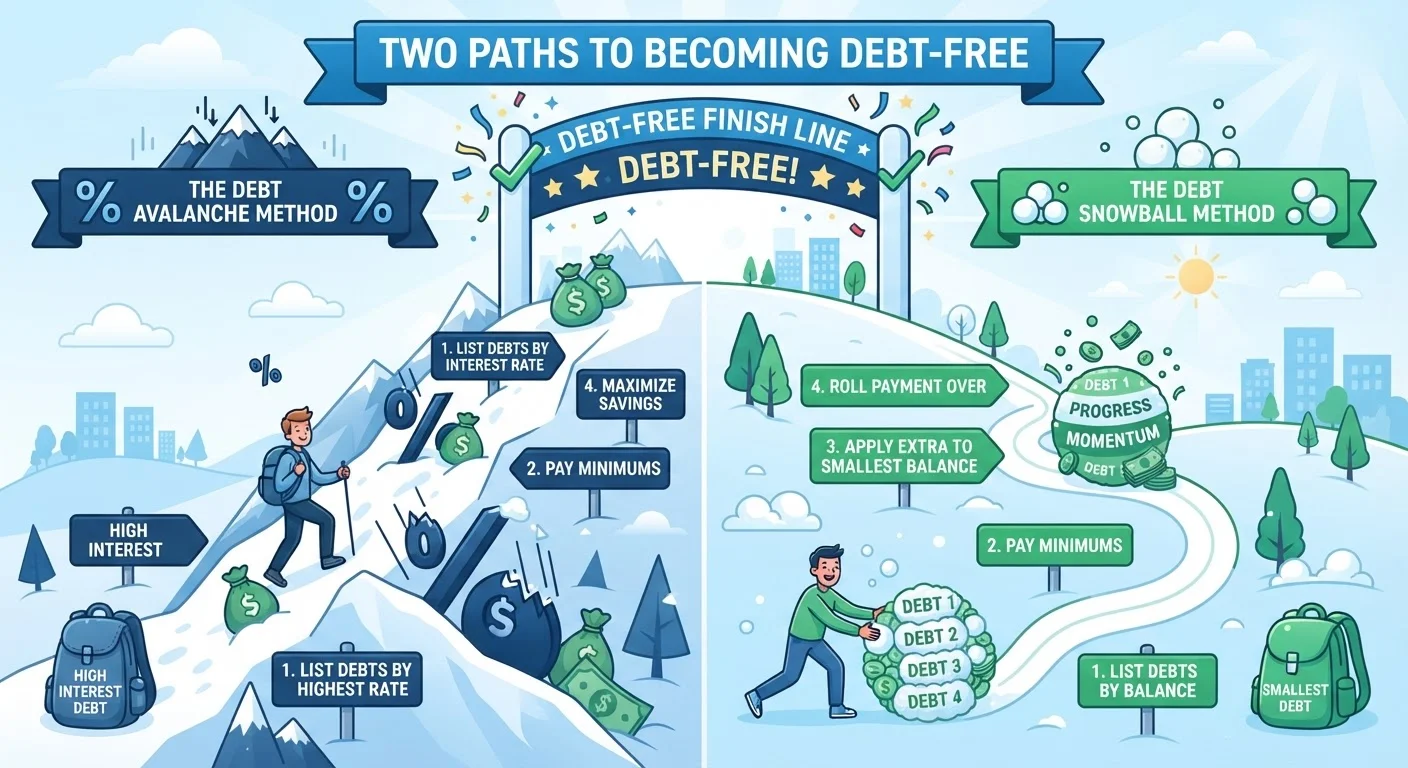
Photo credit: FaqInsider.com
In this article
Two popular payoff strategies, one important choice. See how the avalanche and snowball methods differ in cost, speed, and psychological impact.
Key Takeaways
- The debt avalanche targets your highest-interest balance first, saving the most money over time.
- The debt snowball pays off your smallest balance first, building motivation through quick wins.
- Neither method requires extra income - both work by redirecting freed-up minimum payments.
- Your personality and financial situation should guide which strategy you choose.
- Both methods outperform making only minimum payments on every account.
How Each Method Works
Both strategies share the same basic mechanic: you make minimum payments on all your debts, then direct any extra money toward one target account. The difference is how you pick that target.
Debt Avalanche: You rank your debts from highest interest rate to lowest. Your extra payment goes toward the top-of-list account. Once that balance hits zero, you roll that freed-up payment into the next highest-rate debt. You pay less interest overall because you're neutralizing the most expensive debt first.
Debt Snowball: You rank your debts from smallest balance to largest, regardless of interest rate. Your extra money attacks the smallest balance first. Each time you eliminate an account, you roll that payment into the next smallest. The momentum of closing accounts is the engine.
Before committing to either approach, it helps to have a clear picture of every balance, rate, and minimum payment you carry. Our personal debt audit checklist walks you through exactly that.
| Criteria | Debt Avalanche | Debt Snowball | |
|---|---|---|---|
| Payoff order | Highest interest rate first | Smallest balance first | |
| Total interest paid | Lower - mathematically optimal | Potentially higher | |
| Time to first account closed | Slower if high-rate debt is large | Faster - targets small balances | |
| Motivational impact | Delayed wins; requires discipline | Frequent wins; builds momentum | |
| Best when rates differ significantly | Yes - savings are meaningful | Less advantageous | |
| Best for consistent past behavior | Those with strong financial discipline | Those who need behavioral reinforcement |
The Real Cost Difference
The interest savings from the avalanche method can be significant, especially if you carry high-rate debt like credit cards. Consider a simplified example: if you have three debts - a $5,000 card at 22% APR, a $2,000 card at 14% APR, and a $1,500 personal loan at 9% - the avalanche targets the 22% card first. The snowball targets the $1,500 loan first, allowing the 22% balance to keep compounding longer.
The gap in total interest paid between the two methods varies widely depending on balances and rates, but in high-interest scenarios the avalanche can save hundreds or even thousands of dollars. However, this advantage shrinks when all your debts carry similar interest rates.
~$1,000+
Potential interest savings with avalanche
Interest savings vary widely, but carrying high-rate revolving debt like credit cards amplifies the gap between avalanche and snowball outcomes.
77%
Americans carrying some form of debt
According to Federal Reserve consumer finance surveys, the large majority of U.S. households carry at least one form of debt, making repayment strategy broadly relevant.
It's worth noting that neither strategy eliminates debt faster than throwing extra money at the problem in general - the real lever is how much extra you can pay each month. For a broader look at staying in control of what you owe, see our guide on managing debt without letting it manage you.
The Psychology Behind Each Approach
Research in behavioral finance consistently shows that people are more likely to continue a plan when they experience tangible progress. The snowball method is built on this insight. Closing out a balance - even a small one - creates a sense of accomplishment that reinforces the behavior. For many people, that emotional reward is what keeps them from abandoning their plan when money gets tight.
The avalanche, by contrast, can feel slow at the start. If your highest-rate debt also carries the largest balance, you might be months or years into repayment before your first account closes. That can erode motivation even when you're doing everything right mathematically.
This is not a trivial concern. A strategy you abandon halfway through costs more than an imperfect strategy you follow to completion. Honest self-assessment matters here: if you've struggled to stay consistent with financial plans in the past, the snowball's built-in rewards may be worth the added interest cost.
Choosing the Right Method for Your Situation
There's no universally correct answer, but a few factors can point you in a clear direction.
- Similar interest rates across your debts: Choose the snowball. When rate differences are small, the interest savings from the avalanche are minimal - you might as well get the motivation boost.
- One or two very high-rate accounts dominating your debt: The avalanche makes a stronger case. The savings can be material, and your highest-rate balance is likely the biggest drag on your financial health.
- History of starting but not finishing repayment plans: Lean toward the snowball. Consistency matters more than optimization.
- Strong numerical discipline and a long payoff horizon: The avalanche may suit you well, especially if you track progress in spreadsheets or financial apps that show interest accumulating in real time.
If your debt situation feels more complex - involving creditor negotiations, missed payments, or unmanageable total balances - it may be worth exploring other options. Our overview of debt management plans, settlement, and bankruptcy explains when those paths apply.
One more consideration: as you repay debt, you may face tension between paying down balances and keeping savings intact. Our piece on balancing debt payoff and emergency savings can help you think through that trade-off.
This article is for general informational and educational purposes only and does not constitute personalized financial or legal advice. Please consult a qualified financial professional for guidance specific to your circumstances.

Author
Finance Editorial Team
Finance Editorial Team is the collective byline for our editorial team and contributor network. Articles published under this byline or an editorial pen name are researched, written, and reviewed according to our editorial standards for clarity, consistency, and independence before publication.
View all articles →