
The Debt Avalanche and Debt Snowball Methods, Side by Side
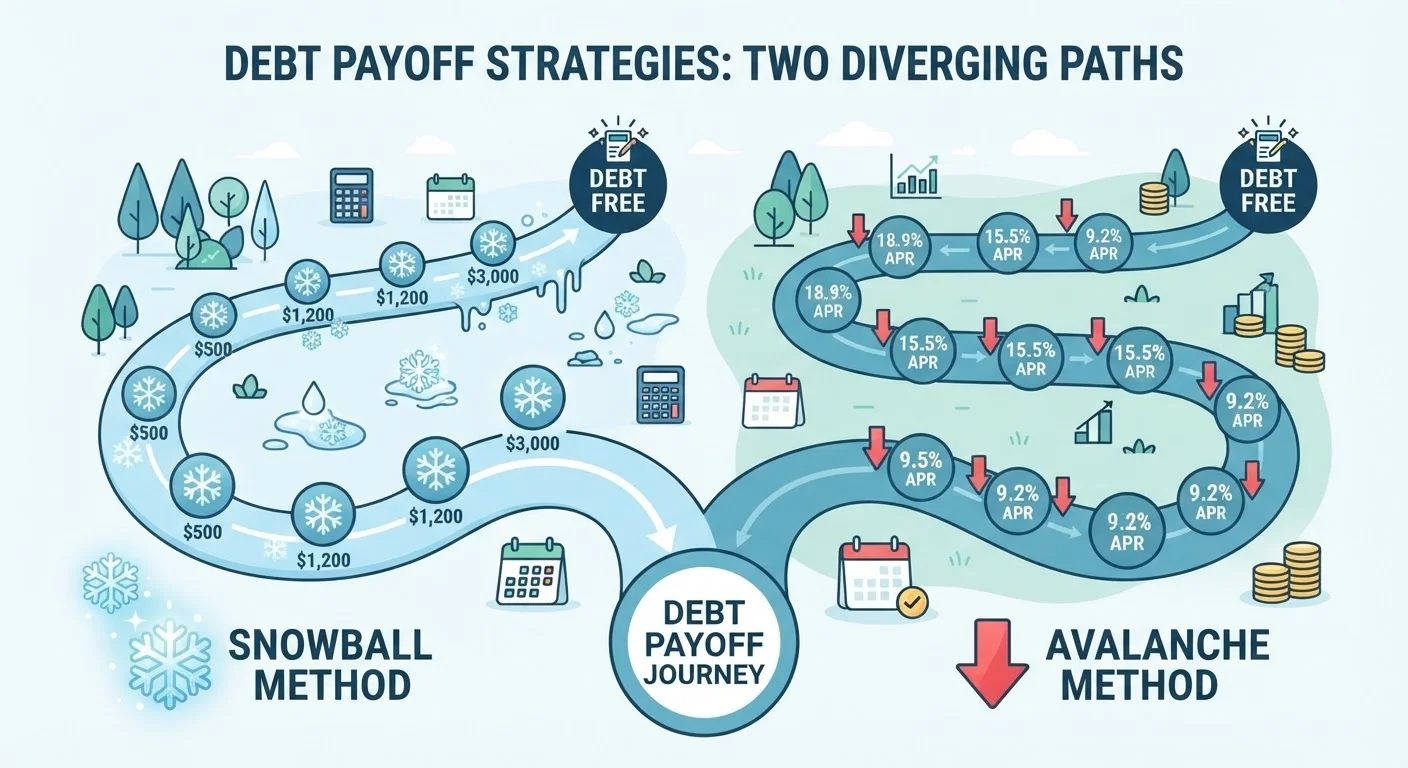
Photo credit: FaqInsider.com
In this article
Two popular payoff strategies, one decision. See how the avalanche and snowball methods compare on cost, speed, and motivation.
Key Takeaways
- The avalanche method targets high-interest debt first, minimizing total interest paid over time.
- The snowball method pays off smallest balances first, building momentum through quick wins.
- The mathematically cheaper option is the avalanche, but the snowball often sustains motivation better.
- Both strategies require a consistent extra payment beyond your minimums to be effective.
- Your best method is the one you'll stick with - consistency matters more than optimization.
How Each Method Works
Both strategies share the same foundation: you pay the minimum on every debt each month, then direct any extra money toward one specific debt. The difference is in which debt you target first.
Debt Avalanche: You rank your debts by interest rate, highest to lowest. Your extra payments go toward the highest-rate balance until it's gone, then you roll that payment to the next highest, and so on. Because high-interest debt costs the most over time, eliminating it first shrinks the total you'll ever pay.
Debt Snowball: You rank debts by outstanding balance, smallest to largest. You attack the smallest debt first, regardless of its interest rate. Once it's cleared, you take everything you were paying on it and add it to the next smallest balance - the "snowball" grows as you go. The appeal is speed: you can eliminate an entire debt within weeks or months, which many people find genuinely energizing.
Before choosing between them, it helps to inventory what you owe - knowing your balances, interest rates, and minimum payments gives you the raw material either method needs.
How They Compare on Cost, Speed, and Motivation
Here's how the two approaches stack up across the factors that matter most to real-world borrowers:
| Debt Avalanche | Debt Snowball | |
|---|---|---|
| Payoff order | Highest interest rate first | Smallest balance first |
| Total interest paid | Lower - often significantly | Higher - sometimes by a notable margin |
| Time to first payoff | Longer if top debt is large | Faster - smallest balance goes first |
| Motivational impact | Delayed; relies on discipline | Strong early wins build momentum |
| Best math fit | Yes - optimal by the numbers | No - trades savings for psychology |
| Simplicity | Requires knowing all interest rates | Only requires knowing balances |
The interest savings from the avalanche method can be meaningful - sometimes hundreds or even thousands of dollars depending on your balances and rates - but those savings are only realized if you stay consistent through what can be a slow start. The avalanche's first target may carry a large balance with a high rate, meaning months of payments before that account closes.
The snowball's early wins are real. Research in behavioral economics suggests that closing accounts, even smaller ones, activates a sense of progress that reinforces continued effort. For some borrowers, that psychological edge is worth the extra interest cost.
Run the Numbers Before You Decide
Many nonprofit credit counseling organizations and personal finance websites offer free debt payoff calculators. Plugging in your actual balances, interest rates, and available monthly payment can show you concretely how much interest each method would cost - and how long each would take. Seeing those projections side by side often makes the decision clearer than any general guideline.
When to Choose the Avalanche
The avalanche method tends to be the stronger fit if:
- You have one or two debts with significantly higher interest rates than the rest - credit cards sitting at 20-29% APR, for example.
- You're motivated by data and long-term efficiency rather than short-term checkpoints.
- Your highest-rate debt isn't enormous, so you'll see it eliminated within a manageable timeline.
- You've already built financial habits that keep you on track without needing external wins to stay motivated.
Keep in mind that neither strategy is a form of personalized financial advice. Your specific mix of debts, income, and expenses all matter. If you're unsure where to start, consider speaking with a nonprofit credit counselor before committing to a plan. For broader context on staying in control of what you owe, see how debt functions in personal finance.
When to Choose the Snowball
The snowball method tends to work better if:
- You have several smaller debts scattered across accounts - store cards, a small personal loan - and the mental weight of multiple obligations is sapping your energy.
- You've tried paying down debt before and lost momentum partway through.
- Your interest rates are similar across accounts, making the mathematical advantage of the avalanche slim.
- You respond well to visible progress and completed goals.
It's also worth noting that eliminating accounts reduces the number of open obligations you're managing each month, which can simplify your monthly budget considerably.
If your debt has grown to the point where neither method feels workable on your current income, there are other paths to explore. Debt management plans, settlement, and bankruptcy each carry different trade-offs and are worth understanding before making any major decisions.
The Factor Both Methods Depend On
Neither strategy works without one thing: a consistent extra payment above your minimums. Even a modest additional amount - $50 or $100 per month - can meaningfully shorten your payoff timeline when directed purposefully.
If finding that extra margin is difficult, the place to look first is your monthly spending. A structured approach to tracking your expenses can surface small adjustments that free up room. You might also weigh whether aggressively paying down debt is the right priority right now, or whether maintaining a small emergency fund should come first - a trade-off worth thinking through carefully before committing all available cash to debt payoff. Balancing debt repayment and savings is genuinely nuanced and depends on your specific situation.
Ultimately, consistency over months and years outweighs which method you pick. Choose the approach that you can realistically sustain, and revisit it periodically as your debt picture changes.
This article is for general informational and educational purposes only and does not constitute personalized financial advice. Consult a qualified financial professional for guidance specific to your situation.

Author
Finance Editorial Team
Finance Editorial Team is the collective byline for our editorial team and contributor network. Articles published under this byline or an editorial pen name are researched, written, and reviewed according to our editorial standards for clarity, consistency, and independence before publication.
View all articles →