
How Saving Changes Across Life Stages: Your 20s Through Your 50s
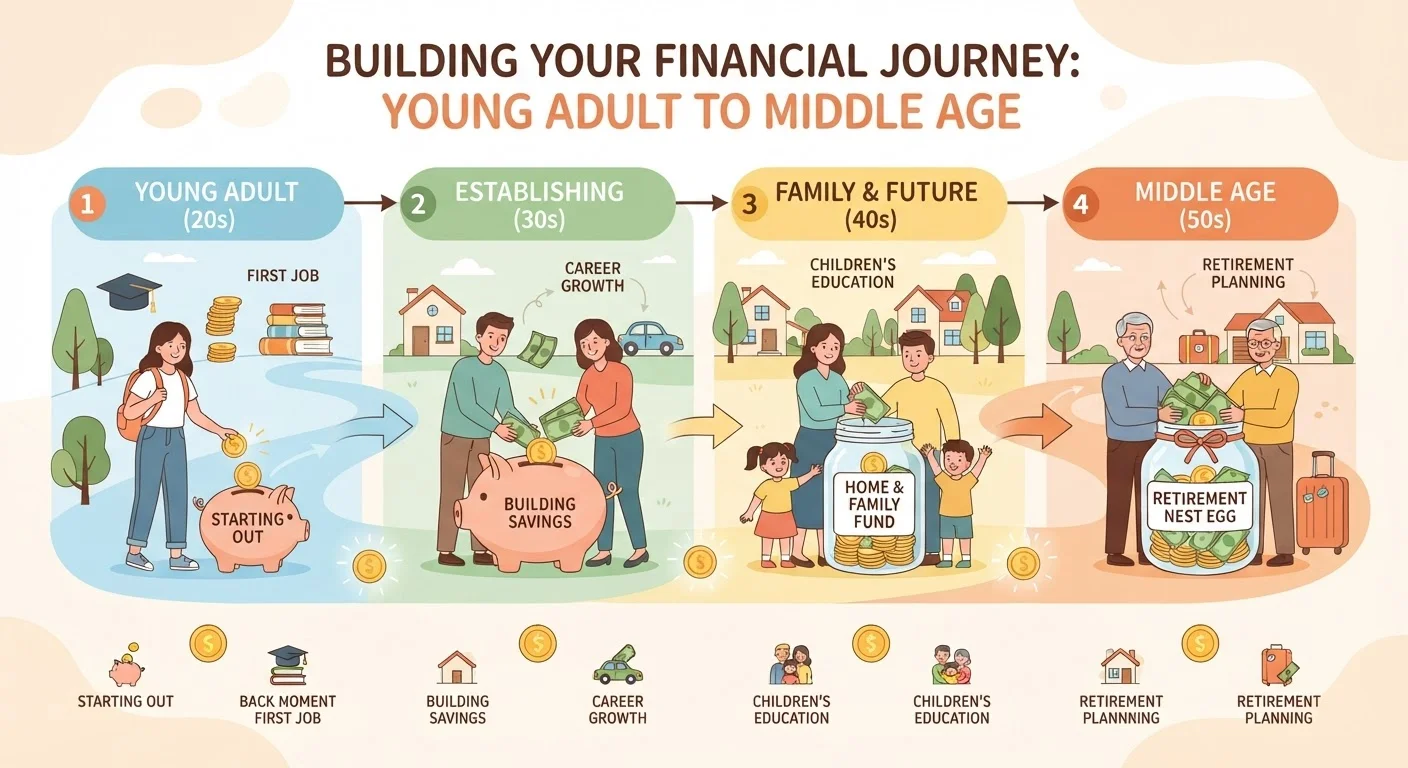
Photo credit: FaqInsider.com
In this article
Savings priorities shift with age, income, and responsibilities. Here's how the fundamentals of emergency saving apply—and adapt—at different points in life.
Key Takeaways
- Saving priorities shift significantly across each decade of adult life, but the habit itself should start as early as possible.
- Your 20s are about building the saving habit and a starter emergency fund, even on a modest income.
- Your 30s and 40s often bring competing financial demands; a clear priority order prevents paralysis.
- By your 50s, catch-up contributions and expense reduction become the most powerful tools available.
- No single saving rate fits every life stage-flexibility and consistency matter more than perfection.
Why Life Stage Matters for Saving
Most savings advice reads as if everyone has the same income, the same obligations, and the same timeline. They don't. A 24-year-old renting a studio apartment and a 48-year-old paying a mortgage, college tuition, and elder care costs are not facing the same financial landscape-and they shouldn't follow identical strategies.
What does remain constant is the core behavior: consistently setting money aside before spending it all. The details-how much, in what account, toward which goal-are what shift. Understanding those shifts can help you make better decisions at each stage rather than feeling behind because you're not hitting someone else's benchmark.
This article is general financial education, not personalized advice. For guidance tailored to your specific situation, consult a licensed financial professional.
Your 20s: Build the Habit Before the Balance
In your 20s, income is often limited and inconsistent. That's not a reason to delay saving-it's actually the most important reason to start small and start now. The primary goal in this decade is developing an automatic saving reflex, not reaching a specific dollar amount.
A useful first target is a starter emergency fund of $500 to $1,000. This modest cushion handles minor setbacks-a car repair, a medical copay-without pushing you into credit card debt. From there, the conventional guidance is to work toward three to six months of essential expenses, though that target can feel distant early on. Small, low-friction saving tactics can help close that gap without a dramatic lifestyle overhaul.
If your employer offers a retirement plan with any matching contribution, capturing that match is a high-priority move-it is essentially part of your compensation. Beyond that, keeping expenses lean while income is low sets habits that compound in value over time.
Automate Before You Can Spend It
In your 20s especially, setting up an automatic transfer to savings on payday-even $25 or $50-removes the decision entirely. You don't have to rely on willpower or remember to save. Most banks and credit unions allow you to schedule recurring transfers at no cost. Starting with a small, sustainable amount and increasing it gradually tends to stick better than aggressive targets that collapse after a few months.
Your 30s: Competing Priorities, Clearer Order
The 30s frequently bring a cluster of simultaneous financial demands: a mortgage or rising rent, a growing family, student loan repayment, and the beginning of serious retirement saving. The danger here is not a lack of income-many people see their earnings rise in this decade-but a lack of prioritization that leads to spending growth that outpaces income growth.
A workable priority order for most households: (1) maintain your emergency fund at three to six months of expenses, (2) capture any employer retirement match, (3) pay down high-interest debt, (4) increase retirement contributions toward 10-15% of gross income over time. The 50/30/20 budgeting framework offers a straightforward way to allocate income across needs, wants, and savings during this phase.
If budgeting feels stretched, realistic strategies for average earners can help identify room that isn't obvious at first.
Your 40s: Peak Expenses, Maximum Opportunity
The 40s are often the decade of peak spending: mortgages, teenagers, possible care for aging parents, and the temptation to upgrade lifestyle as income rises. They can also be the decade when retirement saving either accelerates meaningfully or stalls.
At this stage, a budget audit-a systematic review of every recurring expense-frequently uncovers significant room. Subscriptions, insurance premiums, and discretionary categories that crept up over years are worth renegotiating or cutting. Those redirected dollars can go toward debt elimination and retirement accounts simultaneously.
Common mistakes at this stage include pausing retirement contributions to pay for college costs or home renovations, and keeping too little in an accessible emergency fund. These missteps can set back progress by years. Retirement savings generally cannot be rebuilt as easily as other goals, so protecting contributions in this decade matters enormously.
| Your 20s | Your 30s | Your 40s | Your 50s | |
|---|---|---|---|---|
| Primary saving goal | Starter emergency fund | Full emergency fund + retirement start | Retirement acceleration + debt paydown | Catch-up retirement contributions |
| Typical income situation | Entry-level, variable | Rising, stretched by obligations | Peak earnings, peak expenses | Stable, expenses beginning to ease |
| Biggest risk | Skipping saving entirely | Lifestyle inflation outpacing income | Pausing retirement for short-term costs | Under-saving with little time to recover |
| Key savings mechanism | Automation, small amounts | Priority ordering, employer match | Budget audit, debt elimination | Catch-up contributions, expense restructuring |
| Emergency fund target | $500-$1,000 starter | 3-6 months expenses | 6 months expenses | 6+ months expenses |
| Retirement focus | Capture employer match if available | 10-15% of income over time | Protect existing contributions | Maximize catch-up contributions |
Your 50s: Catch-Up and Course Correction
By your 50s, the time horizon for retirement is visible. Federal tax rules allow workers 50 and older to make additional catch-up contributions to retirement accounts beyond standard annual limits-a meaningful advantage if you have room in your budget to use it. (Contribution limits are set by the IRS and updated periodically; verify current figures at IRS.gov.)
This decade is also when expense restructuring pays the highest dividend. Children leaving the household, a paid-off car, or a mortgage approaching its final years can free up cash flow that didn't exist before. Redirecting those amounts directly into retirement and liquid savings-rather than absorbing them into lifestyle inflation-can dramatically improve your position within a few years.
Saving behaviors that survive life disruptions are especially valuable at this stage. Automating transfers so decisions don't rely on monthly willpower is one of the most reliable mechanisms available, regardless of age. For a broader view of how emergency saving fits into long-term financial resilience, see the full picture on emergency savings.

Author
Finance Editorial Team
Finance Editorial Team is the collective byline for our editorial team and contributor network. Articles published under this byline or an editorial pen name are researched, written, and reviewed according to our editorial standards for clarity, consistency, and independence before publication.
View all articles →