
FHA, Conventional, VA, and USDA Loans Side by Side
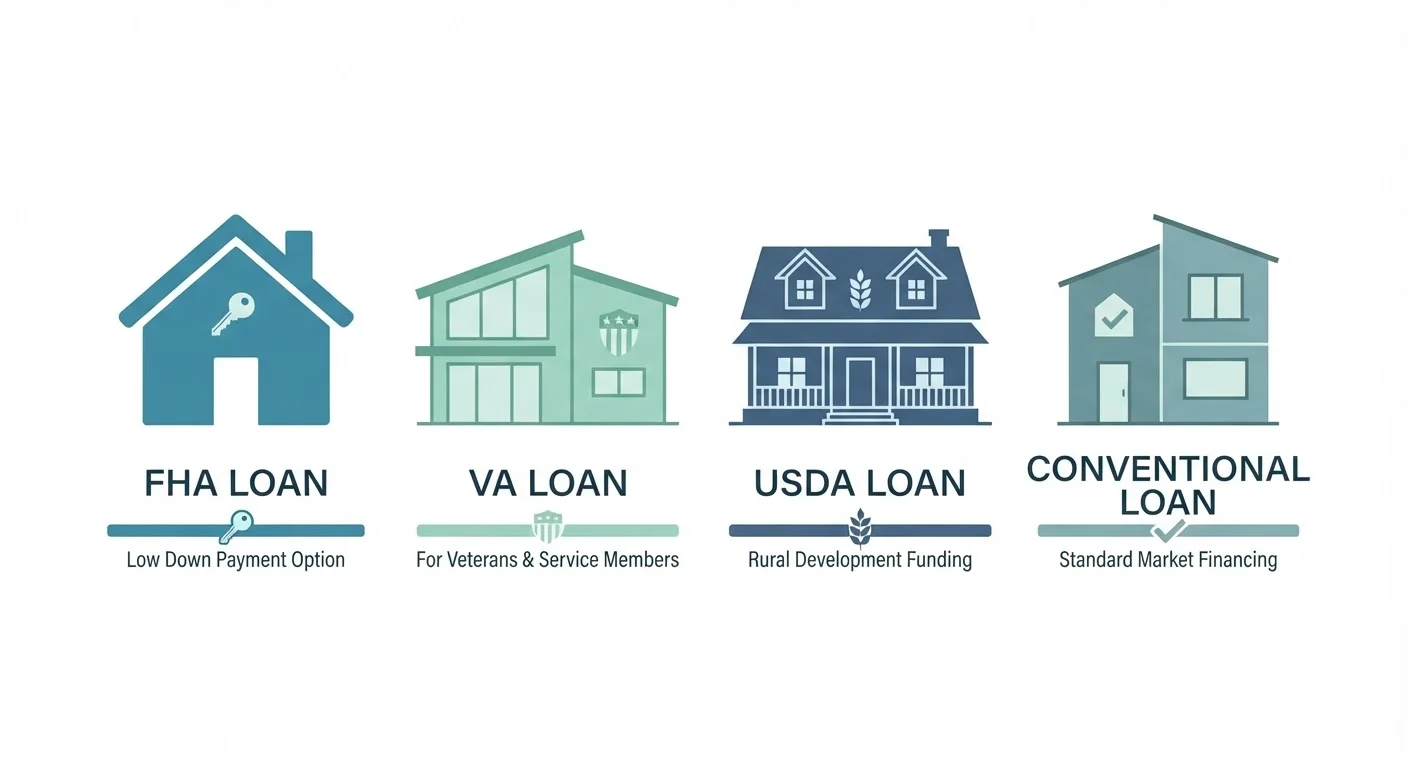
Photo credit: FaqInsider.com
In this article
Each federally backed and conventional loan type carries different eligibility rules, costs, and trade-offs. Here's how they stack up.
Key Takeaways
- VA and USDA loans offer zero down payment options, but each carries strict eligibility requirements.
- FHA loans accept lower credit scores but require mortgage insurance premiums for the life of the loan in most cases.
- Conventional loans become cost-effective once a borrower can put at least 20% down and has strong credit.
- Loan choice affects not just your interest rate but also upfront fees, insurance costs, and long-term flexibility.
- Consulting a HUD-approved housing counselor can help you identify which loan type fits your specific situation.
What Sets These Four Loan Types Apart
When shopping for a mortgage, most U.S. buyers will encounter four primary loan structures: FHA, Conventional, VA, and USDA. Three of these are government-backed - meaning a federal agency insures the lender against default - while conventional loans are not. That distinction shapes everything from required down payments to how mortgage insurance is handled.
Before diving into each type, it helps to review your financial readiness. See our financial readiness checklist to assess your credit, debt load, and documentation before applying. Your credit score, service history, income, and target property location will largely determine which loan category you can access - and which makes the most financial sense.
| FHA | Conventional | VA | USDA | |
|---|---|---|---|---|
| Government backed? | Yes (FHA) | No | Yes (VA) | Yes (USDA) |
| Minimum down payment | 3.5% (580+ score) | 3%-20%+ | 0% | 0% |
| Minimum credit score | 500-580 | 620 (typical) | No VA minimum* | 640 (typical) |
| Mortgage insurance | MIP (often lifelong) | PMI (cancelable) | None (funding fee) | Guarantee fee |
| Property eligibility | Primary residence | Most property types | Primary residence | Rural/suburban areas only |
| Who qualifies | Most buyers | Creditworthy buyers | Veterans/service members | Low-to-moderate income, rural |
| Loan limits | County-based | FHFA conforming limits | No limit (full entitlement) | Area-based limits |
FHA Loans: Accessible but With Long-Term Costs
Insured by the Federal Housing Administration, FHA loans are designed to expand homeownership access. They accept credit scores as low as 500 (with 10% down) or 580 (with 3.5% down), making them a common route for first-time buyers or those rebuilding credit.
The trade-off is mortgage insurance premiums (MIP). FHA borrowers pay an upfront MIP of 1.75% of the loan amount, plus an annual premium - currently ranging from 0.15% to 0.75% depending on loan size and term. Critically, for most FHA loans with less than 10% down, MIP remains for the life of the loan, unlike private mortgage insurance (PMI) on conventional loans, which can be canceled once you reach 20% equity.
FHA loans also have loan limits set by county. You can find current limits through the FHA's official resources. They are also limited to primary residences. For a deeper look at down payment expectations, see our article on common down payment misconceptions.
Conventional Loans: Flexible for Qualified Borrowers
Conventional loans are not government-insured, which means lenders take on more risk - and typically require stronger borrower profiles. Most lenders look for a credit score of at least 620, though the best rates generally go to borrowers above 740. Down payments can be as low as 3% for certain programs, though putting down less than 20% triggers private mortgage insurance (PMI).
PMI costs vary but generally run between 0.2% and 2% of the loan amount annually. Unlike FHA MIP, PMI can be canceled once your loan-to-value ratio drops to 80%, making conventional loans potentially cheaper over the long run for borrowers who build equity quickly.
Conventional loans also come in conforming and jumbo varieties. Conforming loans must fall within limits set annually by the Federal Housing Finance Agency (FHFA) - in 2024, the baseline limit is $766,550 for most U.S. counties. Jumbo loans exceed those limits and typically require even stronger credit and larger down payments. You'll also want to consider rate structure; our guide on fixed-rate vs. adjustable-rate mortgages explains how rate type interacts with any loan program.
Check Your Eligibility Before Ruling Anything Out
Many buyers assume they don't qualify for VA or USDA loans without checking. The VA's eligibility portal and the USDA's property eligibility map are free, publicly accessible tools. Even if a rural address surprises you, some suburban areas qualify under USDA guidelines. Always verify directly with the administering agency or a licensed lender before drawing conclusions.
VA and USDA Loans: Zero Down, Strict Eligibility
VA loans, backed by the U.S. Department of Veterans Affairs, are available to eligible veterans, active-duty service members, National Guard and Reserve members, and certain surviving spouses. Their headline advantage: no down payment required and no ongoing mortgage insurance. Instead, most borrowers pay a one-time funding fee - ranging from 1.25% to 3.3% of the loan amount - though certain veterans with service-connected disabilities may be exempt.
VA loans also carry competitive interest rates and no loan limit for borrowers with full entitlement, though lenders may impose their own caps based on income and credit.
USDA loans, backed by the U.S. Department of Agriculture, similarly require no down payment but are limited to properties in USDA-designated rural and certain suburban areas - and borrowers must fall within area income limits, generally not exceeding 115% of the area median income. USDA loans include an upfront guarantee fee (1% of the loan) and an annual fee (0.35%), both lower than FHA premiums.
If you qualify for either program, they represent some of the most favorable mortgage terms available. State and local programs may also layer additional assistance on top - see our overview of first-time homebuyer assistance programs for context.
This article provides general educational information about mortgage loan types and is not personalized financial or legal advice. Consult a licensed mortgage professional or HUD-approved housing counselor for guidance specific to your situation.

Author
Real Estate Editorial Team
Real Estate Editorial Team is the collective byline for our editorial team and contributor network. Articles published under this byline or an editorial pen name are researched, written, and reviewed according to our editorial standards for clarity, consistency, and independence before publication.
View all articles →