
How Interest Rates Shape What You Can Afford - and What Gets Listed
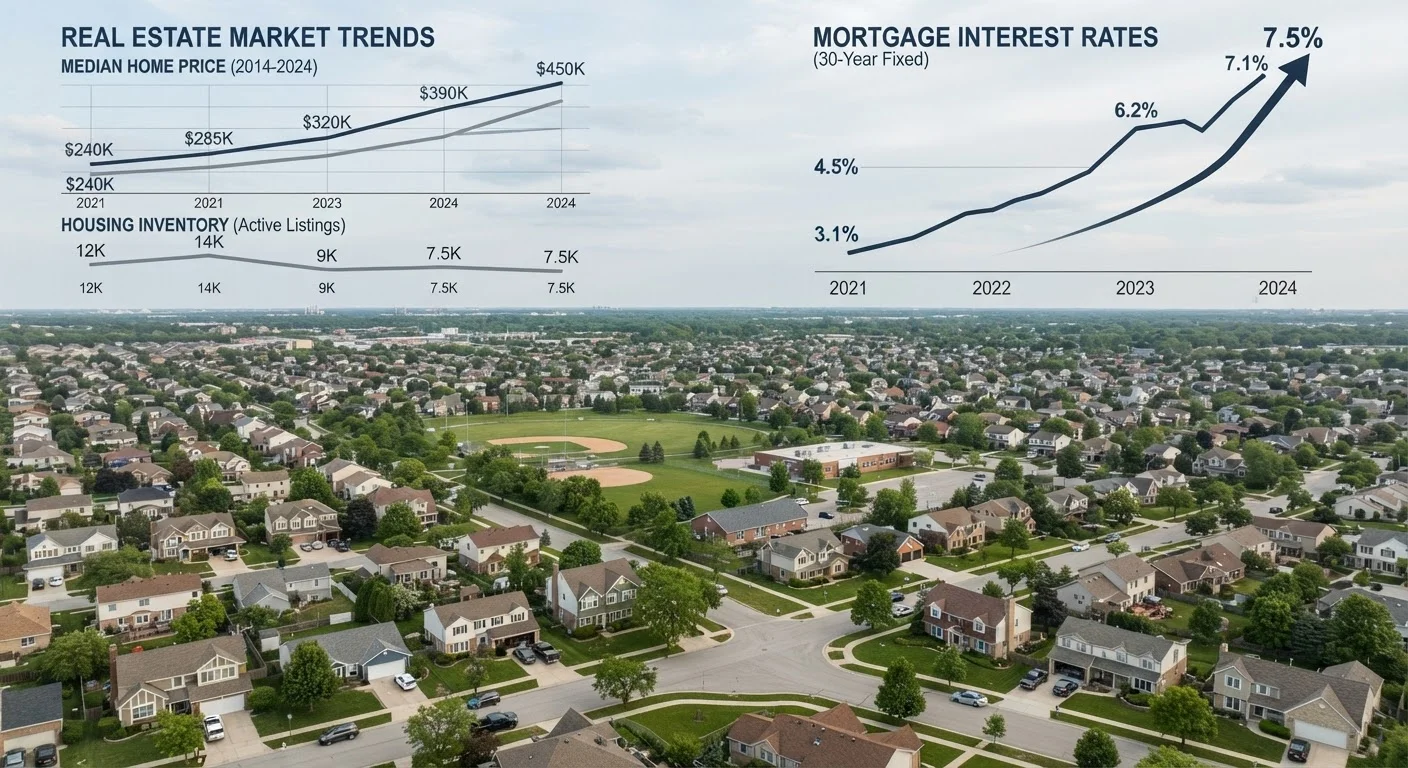
Photo credit: FaqInsider.com
In this article
Rising or falling mortgage rates ripple through both the buyer and seller sides of the market. Here's how that relationship actually works.
Key Takeaways
- A 1-percentage-point rise in mortgage rates can reduce a buyer's purchasing power by roughly 10%.
- Higher rates discourage existing homeowners from selling, creating a 'rate lock-in' effect that shrinks inventory.
- Low inventory can prevent home prices from falling even when buyer demand drops.
- Your credit score significantly affects the rate you actually receive - not just whether you qualify.
- Understanding rate dynamics helps buyers and sellers time decisions more strategically.
How Rates Translate Into Buying Power
Mortgage interest rates are one of the most powerful - and least intuitive - forces in housing affordability. The mechanism is straightforward: lenders qualify buyers based on monthly payment capacity, not total purchase price. When rates rise, a larger share of each monthly payment goes toward interest, leaving less room for principal. That arithmetic directly limits how expensive a home a buyer can carry.
Consider a buyer approved for a $2,200 monthly principal-and-interest payment. At a 5% interest rate on a 30-year fixed loan, that budget supports roughly a $410,000 mortgage. At 7%, that same $2,200 per month covers only around $330,000. The buyer's income hasn't changed. Their savings haven't changed. But their effective purchasing power has dropped by approximately $80,000.
~10%
Purchasing power lost per 1-point rate increase
A commonly cited rule of thumb among mortgage professionals is that each percentage point increase in rate reduces a buyer's affordable loan amount by approximately 10%, assuming a fixed monthly payment target.
~$250/mo
Extra monthly cost of 1% higher rate on $400K loan
On a standard 30-year fixed mortgage of $400,000, moving from a 6% to a 7% rate adds roughly $250 per month to the principal-and-interest payment, illustrating how rate changes accumulate over time.
Millions
Homeowners estimated to be rate-locked
Housing economists have noted that a substantial share of U.S. homeowners hold mortgages well below current market rates, creating a widespread disincentive to sell that has constrained resale inventory in recent years.
This compression affects the entire demand side of the market simultaneously. When rates rise sharply across a short period, a large segment of prospective buyers either gets priced out entirely or must recalibrate toward lower price points, often increasing competition in more affordable tiers.
The Seller Side: Why Rates Control What Gets Listed
Interest rates don't just affect buyers - they have a profound effect on whether homeowners choose to sell at all. This is the often-overlooked supply dimension of rate dynamics, frequently described as the rate lock-in effect.
When a homeowner carries a mortgage at 3% or 3.5% - rates that were common in 2020 and 2021 - selling their home means giving up that loan. Any new home they purchase would be financed at current market rates, which could be double their existing rate. For many owners, that trade feels financially punishing, so they stay put even if their circumstances would otherwise lead them to sell.
If You're a Seller, Consider Timing Carefully
Homeowners who are not rate-locked - such as those who own their home outright or who are relocating regardless of rate environment - may actually find less competition from other sellers in a high-rate market. Reduced listing inventory can work in a motivated seller's favor. However, fewer qualified buyers means pricing expectations may need to be realistic.
The result is a constrained supply of homes for sale even when demand is cooling. This is one reason why home prices have proven resilient during rate-driven demand slowdowns: fewer buyers encounter fewer listings, and competition for available inventory remains elevated. For more on this dynamic, see why home prices don't fall as fast as they rise.
Reading the Market When Rates Shift
Understanding how rates shape both buyer affordability and seller behavior helps consumers interpret market data more accurately. A rising-rate environment doesn't automatically mean buyers gain leverage - if inventory is simultaneously shrinking because sellers won't list, price reductions may not materialize.
Conversely, when rates fall, both demand and supply can shift. More buyers re-enter the market, but some locked-in sellers may also choose to move, adding inventory. The interplay between these two forces determines whether falling rates actually make purchasing easier or simply move prices higher.
Seasonal patterns add another layer of complexity. Seasonal inventory shifts interact with rate movements to create periods where conditions are particularly tight or relatively balanced.
For buyers navigating a high-rate environment, the choice between loan types also matters considerably. Fixed-rate and adjustable-rate mortgages carry different risk profiles depending on how long a buyer expects to hold the loan, and that calculus changes when rates are elevated.
This article is for general informational and educational purposes only. It does not constitute financial, legal, or mortgage advice. Readers should consult a licensed mortgage professional, financial adviser, or attorney regarding their individual circumstances before making any real estate or financing decisions.
Frequently Asked Questions

Author
Real Estate Editorial Team
Real Estate Editorial Team is the collective byline for our editorial team and contributor network. Articles published under this byline or an editorial pen name are researched, written, and reviewed according to our editorial standards for clarity, consistency, and independence before publication.
View all articles →