
Renting vs. Buying When the Market Is Uncertain
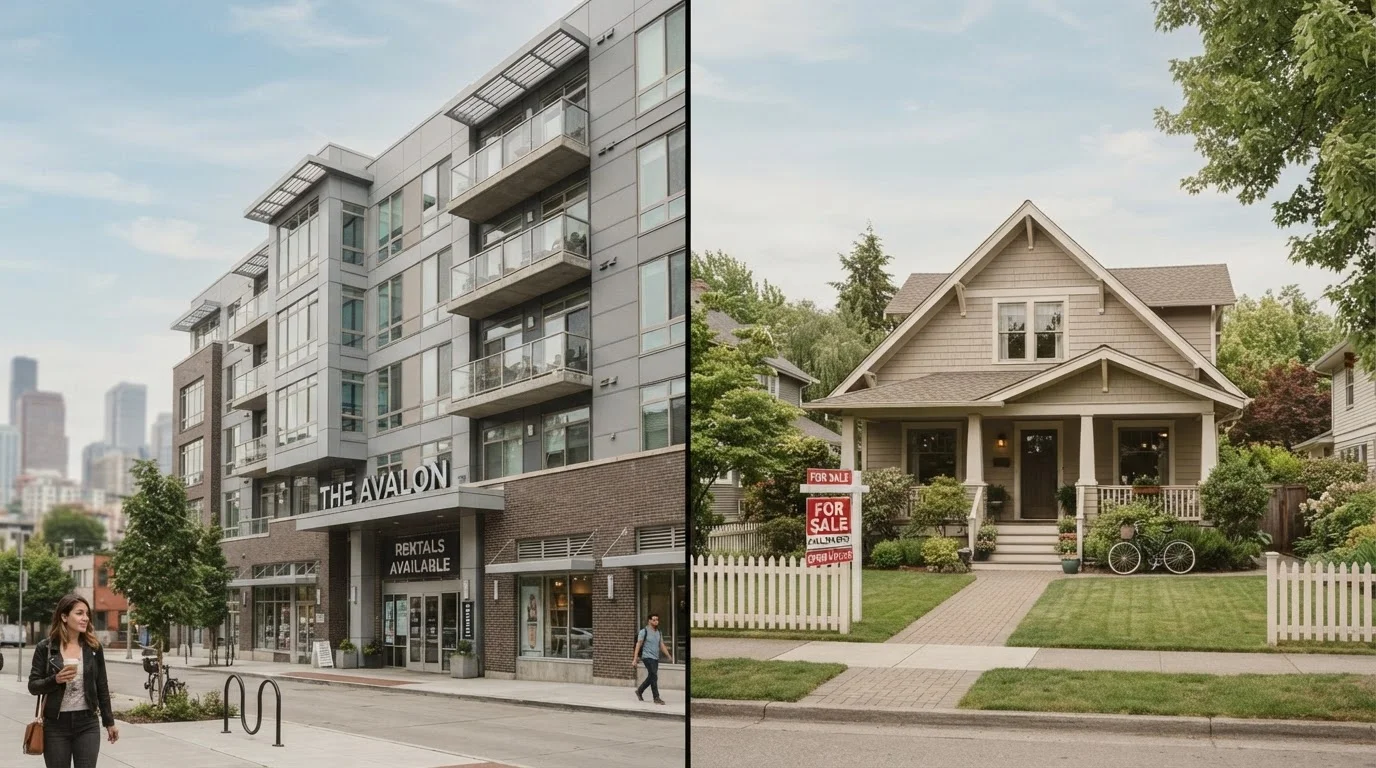
Photo credit: FaqInsider.com
In this article
When the market is unpredictable, the rent-or-buy decision gets harder. Here's a balanced framework for thinking it through without rushing.
Key Takeaways
- Market uncertainty alone should not force a housing decision - personal finances and timeline matter more.
- Renting preserves flexibility and liquidity when economic conditions are unpredictable.
- Buying can still make sense in uncertain markets if the buyer's financial foundation is solid.
- The price-to-rent ratio is a useful tool for gauging relative value in any local market.
- A decision horizon of five or more years generally favors buying over renting.
Flexibility to relocate without major financial penalty
Renters can move at the end of a lease with limited financial consequence, whereas sellers typically pay 5-6% in agent commissions plus additional closing costs - a significant drag if a move is necessary within a short window.
No exposure to falling home values
If prices decline after a purchase, homeowners can face negative equity and may be unable to sell without bringing cash to closing. Renters carry none of this downside price risk.
Lower upfront capital requirement preserves liquidity
Security deposits are typically a fraction of a down payment and closing costs. Keeping capital liquid offers both a financial safety net and the ability to invest elsewhere during uncertain periods.
Predictable short-term housing costs
While rent can increase at lease renewal, renters avoid unpredictable ownership costs such as emergency repairs, rising insurance premiums, or sudden property tax reassessments.
No equity build-up from monthly payments
Rent payments do not contribute to ownership stake. Over a decade, a homeowner's mortgage payments reduce principal and build wealth through equity, while a renter has no equivalent asset to show for the same expenditure.
Exposure to rent increases at lease renewal
In many U.S. markets, rents have risen faster than general inflation over multi-year periods. Without rent stabilization protections, a renter's housing cost can increase significantly at each renewal.
Prolonged waiting can mean higher purchase prices
Delaying a purchase in hopes of a price drop that does not materialize may result in buying later at a higher price or rate environment, negating the savings anticipated by waiting.
Less stability and control over the living situation
Landlords can choose not to renew leases, sell the property, or raise rents substantially. This lack of permanence is a real lifestyle cost that is difficult to quantify financially.
Why Market Uncertainty Complicates the Decision
The rent-or-buy question is never simple, but it becomes especially charged when mortgage rates are volatile, home prices seem disconnected from incomes, and economic forecasts conflict. Many people freeze - waiting for a "clear signal" that rarely arrives. Others rush to buy out of fear that prices will run further ahead, or rush to lock into long leases convinced that a crash is coming.
Neither reaction is grounded in a reliable framework. The honest starting point is acknowledging that no one can time the housing market with precision - not investors, not economists, and not real estate professionals. What you can control is how well-suited your personal financial situation and life circumstances are to each path. For a broader look at how the financial and lifestyle dimensions compare under normal conditions, see our full trade-off analysis.
The Case for Renting When Markets Are Unpredictable
Renting provides a form of optionality that ownership cannot. When prices may fall, locking into a large mortgage exposes a buyer to potential negative equity - a situation where the home's market value drops below the outstanding loan balance. Renters sidestep that risk entirely.
Flexibility to relocate without major financial penalty
Renters can move at the end of a lease with limited financial consequence, whereas sellers typically pay 5-6% in agent commissions plus additional closing costs - a significant drag if a move is necessary within a short window.
No exposure to falling home values
If prices decline after a purchase, homeowners can face negative equity and may be unable to sell without bringing cash to closing. Renters carry none of this downside price risk.
Lower upfront capital requirement preserves liquidity
Security deposits are typically a fraction of a down payment and closing costs. Keeping capital liquid offers both a financial safety net and the ability to invest elsewhere during uncertain periods.
Predictable short-term housing costs
While rent can increase at lease renewal, renters avoid unpredictable ownership costs such as emergency repairs, rising insurance premiums, or sudden property tax reassessments.
Liquid savings that would otherwise go toward a down payment and closing costs can remain invested or accessible during uncertain periods. This matters because buying a home typically involves 3-6% in closing costs alone, money that is not recoverable if you need to sell quickly. For a deeper look at the essentials of renting, including lease terms and tenant protections, the Renting Basics hub is a useful reference.
The Case for Buying Even in an Uncertain Market
Uncertainty cuts both ways. Waiting for the market to "settle" can mean missing years of equity accumulation, continued rent increases, or a window of relatively lower prices. Buyers who purchased during prior periods of uncertainty - and who stayed in their homes for seven or more years - have generally seen positive outcomes, though past performance does not guarantee future results.
No equity build-up from monthly payments
Rent payments do not contribute to ownership stake. Over a decade, a homeowner's mortgage payments reduce principal and build wealth through equity, while a renter has no equivalent asset to show for the same expenditure.
Exposure to rent increases at lease renewal
In many U.S. markets, rents have risen faster than general inflation over multi-year periods. Without rent stabilization protections, a renter's housing cost can increase significantly at each renewal.
Prolonged waiting can mean higher purchase prices
Delaying a purchase in hopes of a price drop that does not materialize may result in buying later at a higher price or rate environment, negating the savings anticipated by waiting.
Less stability and control over the living situation
Landlords can choose not to renew leases, sell the property, or raise rents substantially. This lack of permanence is a real lifestyle cost that is difficult to quantify financially.
If your income is stable, your credit is strong, your debt-to-income ratio is manageable, and you plan to stay in the home for at least five years, the macroeconomic backdrop matters less than those fundamentals. Monthly mortgage payments, unlike rent in most U.S. markets, are fixed on a 30-year loan - providing its own form of cost predictability. Explore the full homebuying process through our Buying a Home hub.
Using the Price-to-Rent Ratio as a Practical Guide
One concrete metric that can bring structure to an uncertain decision is the price-to-rent ratio - calculated by dividing a home's purchase price by the annual cost of renting a comparable property. As a general guideline used by housing economists:
- A ratio below 15 typically suggests buying may be more cost-effective over time.
- A ratio between 15 and 20 indicates a mixed picture where local factors dominate.
- A ratio above 20 generally favors renting from a pure cost standpoint.
5+ years
Typical break-even horizon for homebuying
Housing economists and financial planners broadly cite a minimum five-year stay as necessary to recover transaction costs and benefit from equity accumulation.
3-6%
Typical closing cost range for home buyers
The Consumer Financial Protection Bureau notes that buyers generally pay between 3% and 6% of the loan amount in closing costs, not including the down payment itself.
>20
Price-to-rent ratio threshold favoring renting
A ratio above 20 - meaning the purchase price exceeds 20 times annual rent for a comparable property - has historically indicated that renting is more cost-efficient in that market.
This ratio varies dramatically by metro area, which is why national headlines about housing affordability often fail to capture what's happening in your specific market. Research your local ratio using recent comparable sale prices and current rental listings before drawing conclusions. For a side-by-side financial comparison of both paths, see our practical financial comparison.
How to Calculate Your Local Price-to-Rent Ratio
Find the median sale price for a home type you would consider buying, then divide it by the annual rent for a comparable unit in the same neighborhood. For example, a $400,000 home in an area where comparable rentals cost $2,000 per month ($24,000 annually) yields a ratio of roughly 16.7. This is a screening tool, not a definitive answer - local tax rates, rent control laws, and individual financial circumstances all affect the outcome.
Questions to Ask Before Deciding
Rather than watching market indexes, prospective buyers and renters facing uncertainty should pressure-test a few personal variables:
- How long do you plan to stay? Break-even on buying typically requires five or more years when accounting for transaction costs and early mortgage interest.
- How stable is your income? A job change, relocation, or career pivot in the near term tilts the math toward renting.
- What is your liquidity cushion? Buying should not exhaust your emergency savings - lenders typically require reserves, and unexpected homeownership costs (repairs, insurance increases, property tax adjustments) are common.
- What does your local market show? A high price-to-rent ratio in your target area strengthens the case for continuing to rent; a low one may favor buying even in a broader uncertain environment.
If you are also evaluating long-term lease structures, our related article renting vs. buying a home: weighing the trade-offs covers the additional lifestyle dimensions worth considering.
This article is for general informational purposes only and does not constitute financial, investment, or legal advice. Consult a licensed financial adviser or real estate professional before making decisions based on your personal circumstances.

Author
Real Estate Editorial Team
Real Estate Editorial Team is the collective byline for our editorial team and contributor network. Articles published under this byline or an editorial pen name are researched, written, and reviewed according to our editorial standards for clarity, consistency, and independence before publication.
View all articles →