
Revolving Credit vs. Installment Loans: A Side-by-Side Look
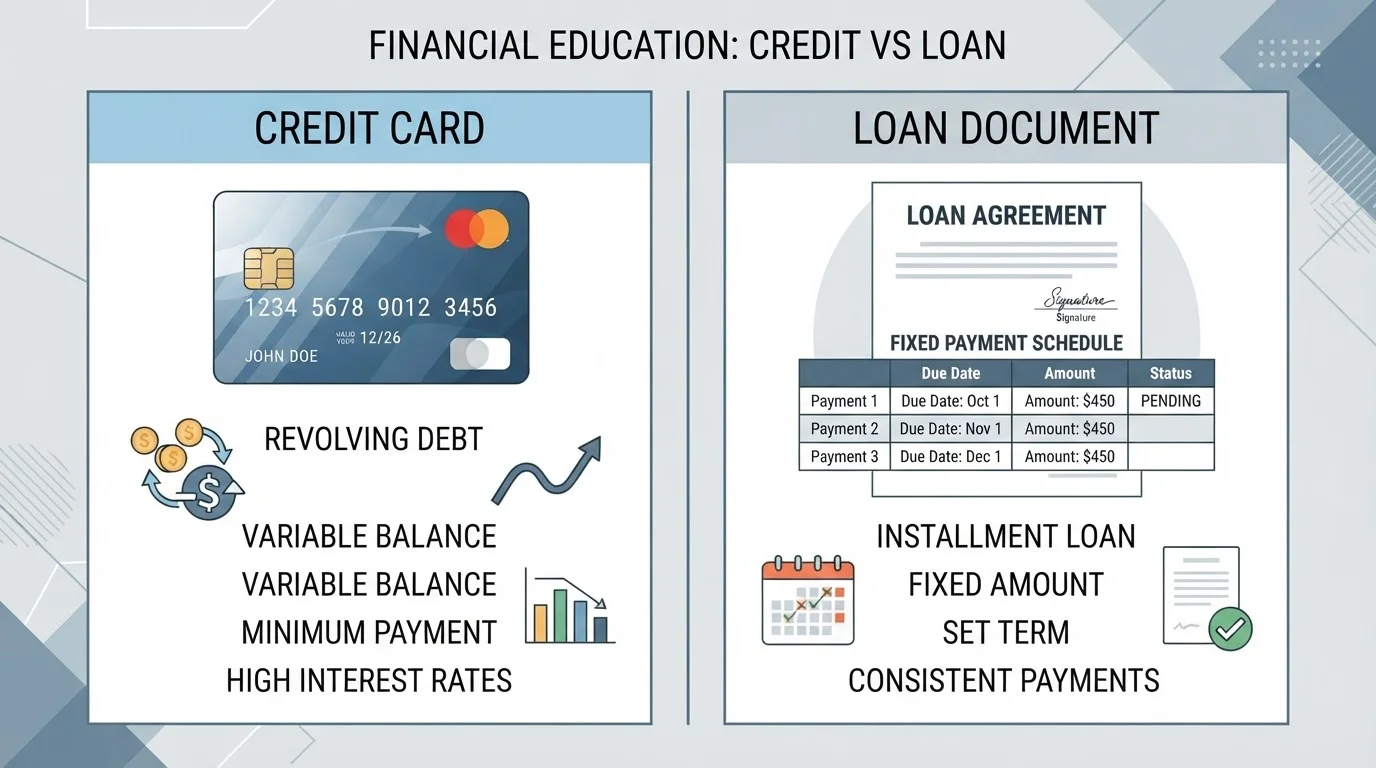
Photo credit: FaqInsider.com
In this article
Credit cards and car loans work very differently. This comparison explains the mechanics, scoring implications, and typical uses of each credit type.
Key Takeaways
- Revolving credit lets you borrow up to a set limit repeatedly; installment loans give you a lump sum you repay over a fixed term.
- Credit utilization - how much of your revolving limit you use - is a major factor in your credit score.
- Installment loans demonstrate your ability to manage long-term debt with consistent payments.
- Having both types of credit in your profile can strengthen your credit mix, one component of your score.
- Interest on revolving credit can compound quickly if you carry a balance; installment loan interest is baked into a fixed schedule.
- Neither type is universally better - the right choice depends on what you're financing and your repayment habits.
How Each Type of Credit Works
Understanding the mechanics behind each credit type removes a lot of the mystery around why your credit report looks the way it does - and how lenders evaluate you. For a broader foundation, see our starter's guide to borrowing money.
Revolving Credit
With revolving credit, a lender approves you for a maximum credit limit. You can borrow any amount up to that limit, repay it (in full or partially), and then borrow again. The balance "revolves" from month to month if you don't pay it off entirely. Credit cards are the most common example; home equity lines of credit (HELOCs) are another.
Each billing cycle, you'll receive a minimum payment due - typically a small percentage of your balance or a flat dollar amount. Carrying a balance beyond that minimum means interest accrues, often at relatively high rates. The amount you owe relative to your credit limit is called your credit utilization ratio, and it plays a significant role in your credit score.
Installment Loans
An installment loan gives you a fixed lump sum upfront. You then repay it in equal, scheduled payments - called installments - over a set period, such as 36 or 60 months. Auto loans, mortgages, student loans, and personal loans all follow this model. To see how the mechanics work in a specific context, our article on how car loans actually work breaks down principal, APR, and total interest paid in plain terms.
With installment loans, your interest rate and monthly payment are typically established at the outset, making it easier to plan your budget. Once you've repaid the loan in full, that account closes - you cannot re-borrow from it.
| Criterion | Revolving Credit | Installment Loans |
|---|---|---|
| Loan structure | Reusable credit line up to a limit | Fixed lump sum, repaid over set term |
| Common examples | Credit cards, HELOCs | Auto loans, mortgages, student loans |
| Monthly payment | Varies with balance | Fixed amount, set at origination |
| Interest accrual | On unpaid balance; can compound | Built into fixed repayment schedule |
| Credit score impact | Utilization ratio is a key factor | Payment history is the primary factor |
| Account reuse | Borrow, repay, and re-borrow repeatedly | Closes when loan is fully repaid |
| Payoff timeline | Open-ended; no fixed end date | Defined term (e.g., 36, 60, 360 months) |
| Best for | Flexible, ongoing expenses | Large, one-time purchases |
How Each Type Affects Your Credit Score
Both revolving credit and installment loans appear on your credit report and influence your score, but through different mechanisms.
Revolving Credit and Utilization
Credit scoring models - including FICO and VantageScore - pay close attention to how much of your available revolving credit you're actually using. This utilization ratio is calculated both per card and across all revolving accounts. Keeping it below 30% is commonly cited as a reasonable guideline, though lower is generally better. A high balance on a credit card can pull your score down quickly; paying it off can raise it just as fast.
Installment Loans and Payment History
Payment history is the single largest factor in most credit scores, and installment loans are a direct test of it. Each on-time monthly payment is a positive data point. Missed or late payments, on the other hand, can significantly damage your score and remain on your credit report for several years.
Credit Mix
Scoring models also consider the variety of credit types you manage. Having both revolving credit and an installment loan - and handling each responsibly - can benefit your credit mix, which typically accounts for a modest portion of your overall score. Your credit score also plays a meaningful role in the terms you'll receive on future borrowing; our article on credit scores and auto financing explains how that plays out in practice.
A Note on Credit Scoring Models
FICO and VantageScore are the two most widely used credit scoring models in the U.S., and they weigh factors somewhat differently. The percentages you see cited - such as "35% for payment history" - are approximations based on FICO's general framework and may not apply exactly to every version of every score. Your lender may use a different model or a different version of a model than the one you check yourself, which can lead to slight score discrepancies. The underlying principles, however - pay on time, keep utilization reasonable, maintain a mix of account types - are broadly consistent across models.
Choosing the Right Tool for the Job
Neither revolving credit nor installment loans is inherently superior - their usefulness depends on what you're financing and how you manage debt.
Use revolving credit when your borrowing needs are ongoing and variable. It's well-suited for everyday purchases, managing cash flow gaps, or covering costs that shift month to month. The key discipline is keeping your balance manageable relative to your limit and, ideally, paying in full each cycle to avoid interest charges.
Use installment loans for defined, large-scale purchases where a fixed repayment schedule makes sense - a vehicle, a home, or a degree. You'll know exactly what you owe each month and exactly when you'll be debt-free. If you're weighing different loan structures for a home purchase, our comparison of FHA, conventional, VA, and USDA loans may also be useful.
If you're newer to credit and deciding which to establish first, explore both options in context: our companion piece on these two debt types covers the broader financial implications of each.
This article is for general informational and educational purposes only. It does not constitute personalized financial or credit advice. Consider consulting a licensed financial professional for guidance tailored to your specific situation.

Author
Finance Editorial Team
Finance Editorial Team is the collective byline for our editorial team and contributor network. Articles published under this byline or an editorial pen name are researched, written, and reviewed according to our editorial standards for clarity, consistency, and independence before publication.
View all articles →