
Fixed-Rate vs. Adjustable-Rate Mortgages: What Changes Over Time
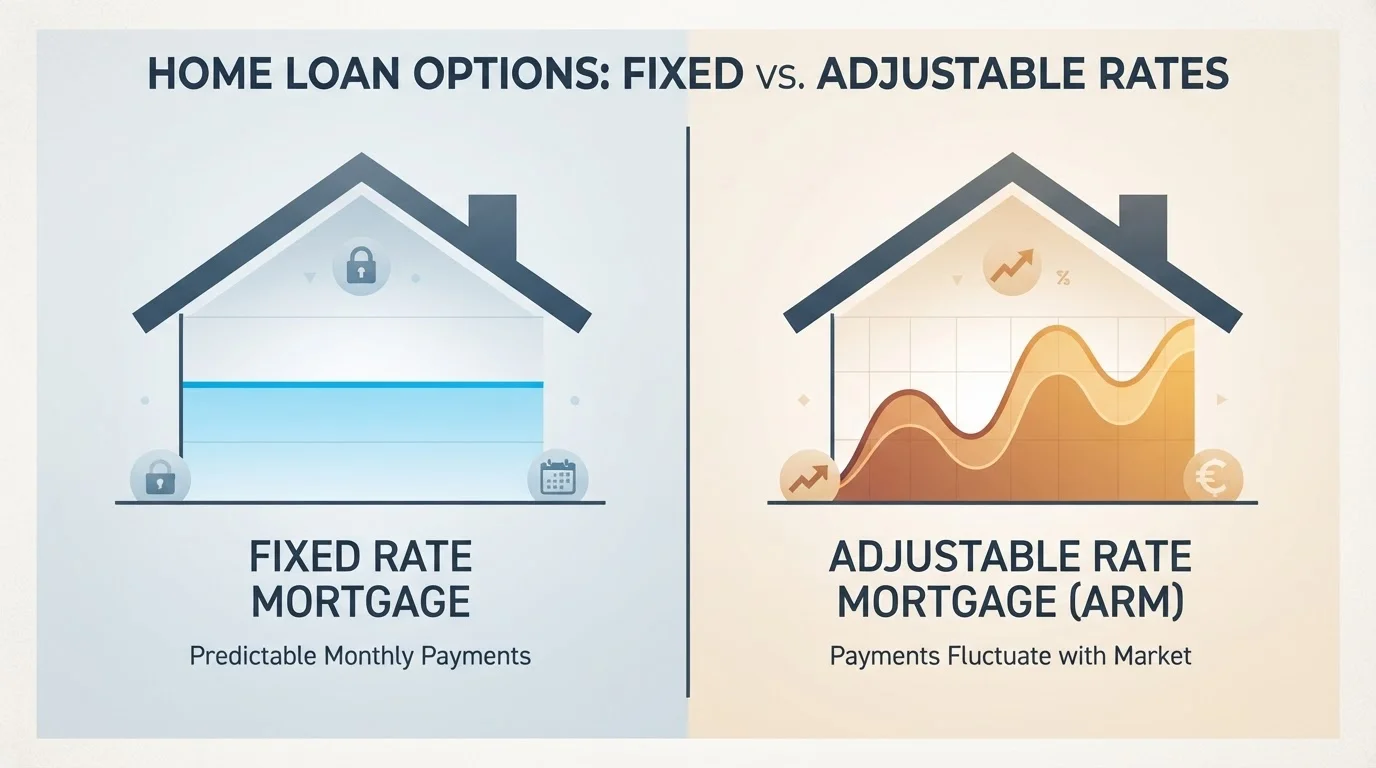
Photo credit: FaqInsider.com
In this article
Understand how fixed and adjustable mortgage rates work, when each tends to cost more, and what factors shape the decision for different buyers.
Key Takeaways
- Fixed-rate mortgages lock in your interest rate for the entire loan term, keeping monthly payments stable.
- ARMs offer a lower introductory rate that adjusts periodically after an initial fixed period ends.
- Rate caps on ARMs limit how much your rate can increase at each adjustment and over the loan's life.
- The right choice depends on how long you plan to stay in the home and your tolerance for payment uncertainty.
- Your credit score and financial profile influence which loan type and rate you qualify for.
How Each Loan Type Works
A fixed-rate mortgage carries the same interest rate from the first payment to the last. Whether your loan term is 15 years or 30 years, neither market swings nor Federal Reserve policy changes affect what you owe each month. That consistency is the defining feature buyers often rely on when planning a long-term budget.
An adjustable-rate mortgage (ARM) works differently. It begins with a fixed introductory period - commonly five, seven, or ten years - during which the rate stays put. After that period ends, the rate adjusts at regular intervals (typically once per year) based on a financial index, such as the Secured Overnight Financing Rate (SOFR), plus a set margin determined by the lender. A 5/1 ARM, for example, holds its initial rate for five years, then adjusts annually thereafter.
ARMs include rate caps - contractual limits that restrict how much the interest rate can rise at any single adjustment and over the life of the loan. Understanding those caps is essential before signing. For more on how broader rate environments affect housing affordability, see how home prices and mortgage rates interact.
| Criterion | Fixed-Rate Mortgage | Adjustable-Rate Mortgage (ARM) |
|---|---|---|
| Interest Rate Over Time | Never changes | Changes after initial fixed period |
| Initial Rate | Typically higher at origination | Typically lower at origination |
| Monthly Payment Stability | Fully predictable | Variable after introductory period |
| Rate Caps | Not applicable | Periodic and lifetime caps apply |
| Best Loan Length | Long-term ownership (10+ years) | Short-to-medium term (under 7 years) |
| Risk to Borrower | Low (rate locked in) | Moderate to high (rate can rise) |
| Common Terms | 15-year, 30-year | 5/1, 7/1, 10/1 ARM |
What Changes - and When - Over the Loan's Life
With a fixed-rate loan, the principal-to-interest ratio inside each payment shifts over time through amortization, but your total monthly payment (excluding taxes and insurance) never changes. Early payments are heavily weighted toward interest; later payments chip away more at principal. The rate itself is immovable.
With an ARM, the first adjustment after the introductory period is where many borrowers feel the biggest impact. Depending on market conditions at that moment, the rate could increase, decrease, or stay roughly the same. Most ARMs carry a periodic cap (limiting each single adjustment, often to 2 percentage points) and a lifetime cap (capping the total rate change over the loan's life, commonly 5-6 percentage points above the starting rate).
Consider a borrower who takes a 7/1 ARM at 5.5% with a 5-percentage-point lifetime cap. Their rate can theoretically reach 10.5% - a significant jump in monthly obligation. That scenario isn't inevitable, but buyers should stress-test their budget against it before committing. Understanding how variable costs behave in a household budget is equally important; see how fixed vs. variable expenses work for useful context.
~70%
Share of U.S. mortgages that are fixed-rate
According to the Federal Reserve's Survey of Consumer Finances, fixed-rate mortgages have consistently dominated the U.S. market, particularly following the 2008 financial crisis.
2-3%
Typical introductory rate discount for ARMs vs. fixed
The spread between ARM initial rates and comparable fixed rates varies with market conditions; during periods of elevated fixed rates, this gap often widens.
5-6 pts
Common ARM lifetime rate cap above starting rate
Most ARM contracts limit total rate increases to 5-6 percentage points over the life of the loan, though terms vary by lender and product.
What Should Drive Your Decision
Three factors generally shape the fixed vs. ARM decision: time horizon, rate environment, and risk tolerance.
Time horizon matters most. If you plan to move or refinance before the ARM's initial period ends, you capture the lower introductory rate without ever facing an adjustment. If you expect to stay longer, a fixed rate removes the guesswork.
Rate environment matters too. When prevailing rates are low by historical standards, locking in a fixed rate is generally attractive. When fixed rates are elevated, the gap between fixed and ARM introductory rates often widens, making ARMs relatively more appealing - though future adjustments remain uncertain.
Risk tolerance is personal. Some buyers find payment variability stressful regardless of the odds; for them, the premium paid for a fixed rate is worth the peace of mind. Others are comfortable managing financial uncertainty and prefer to keep initial payments lower.
Your credit profile also shapes which products you can access and at what rates. How credit scores influence mortgage terms explains how lenders evaluate borrowers and why that affects the specific rates you're offered - for either loan type. For a broader side-by-side overview of these two loan types, our dedicated mortgage comparison guide provides additional detail.
Refinancing Can Change the Equation
Borrowers who start with an ARM aren't locked into it forever. If rates fall or your financial situation changes, refinancing into a fixed-rate loan is an option - though refinancing carries its own costs, including closing fees typically ranging from 2% to 5% of the loan amount. Factor those costs into any comparison between staying with an ARM and refinancing to a fixed rate.
This article is for general informational purposes only and does not constitute financial, mortgage, or legal advice. Consult a licensed mortgage professional or financial adviser before making any loan decisions based on your individual circumstances.

Author
Real Estate Editorial Team
Real Estate Editorial Team is the collective byline for our editorial team and contributor network. Articles published under this byline or an editorial pen name are researched, written, and reviewed according to our editorial standards for clarity, consistency, and independence before publication.
View all articles →