
Why Home Prices and Mortgage Rates Don't Always Move Together
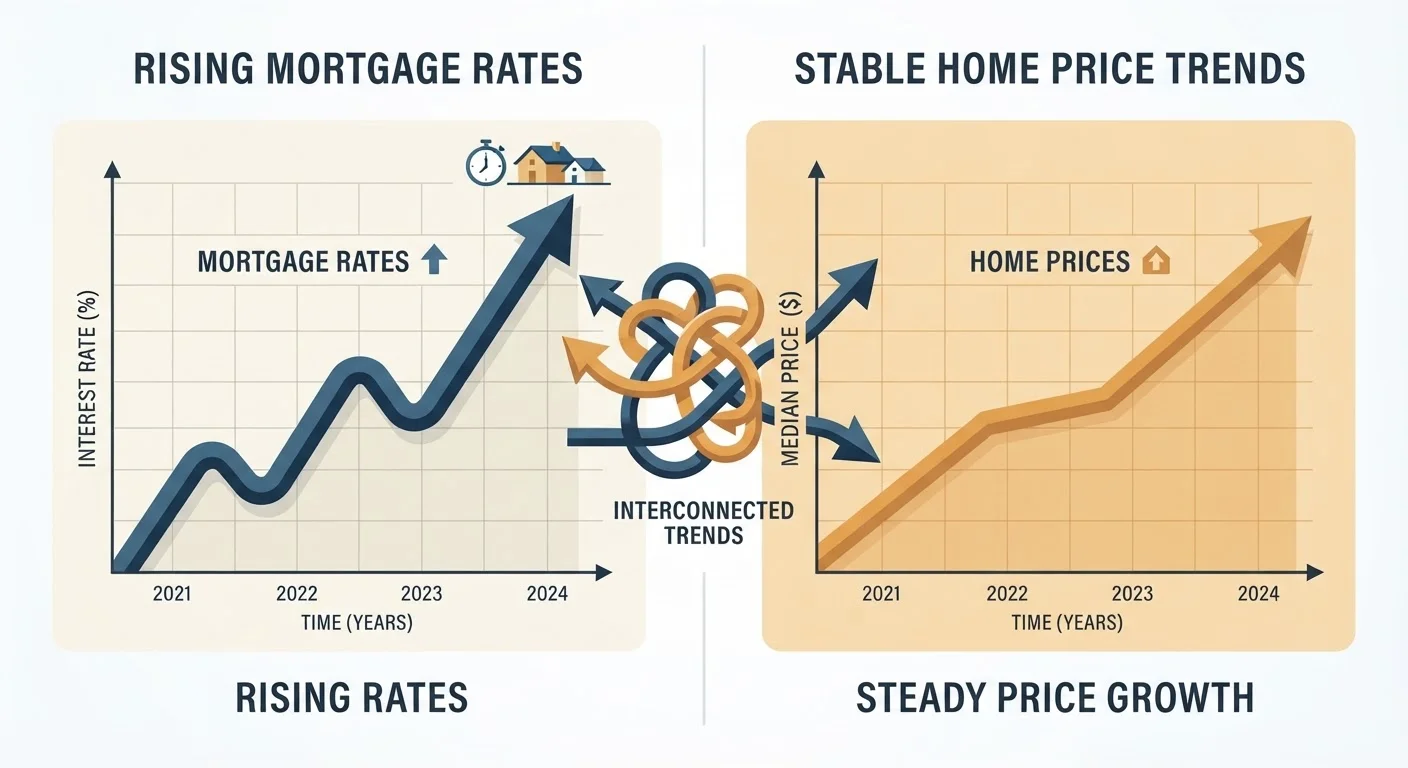
Photo credit: FaqInsider.com
In this article
It's a common assumption that rising rates always cool prices. Here's the more complicated reality — and why timing the market is harder than it sounds.
Key Takeaways
- Rising mortgage rates do not automatically cause home prices to fall.
- Housing supply constraints can keep prices high even when borrowing costs increase.
- Local market conditions often matter more than national rate trends.
- Seller psychology and the 'lock-in effect' can reduce inventory when rates rise, limiting price drops.
- Attempting to time the market based on rates alone carries significant risk.
- Affordability - the combined effect of price and rate - is often a more useful measure than either factor alone.
The Simple Story Most People Believe
The conventional wisdom sounds logical: when the Federal Reserve raises benchmark interest rates, mortgage rates climb, monthly payments become more expensive, fewer buyers can afford homes, demand drops, and prices fall. In a simple, sealed economic system, that chain of events would be predictable.
Real housing markets, however, are not sealed systems. They are shaped by local conditions, seller psychology, available inventory, demographic pressures, and policy decisions - all interacting simultaneously. The result is that mortgage rates and home prices frequently move in ways that defy the simple inverse relationship most people expect.
Understanding why this happens is not just an academic exercise. For buyers and sellers trying to plan a major financial decision, misreading how these forces interact can lead to costly miscalculations - including waiting indefinitely for a price correction that may not materialize. See common beliefs about housing market timing that don't hold up for more on how these assumptions play out in practice.
Why Supply Can Override Rate Effects
The most powerful counterforce to rate-driven price declines is housing supply - or the lack of it. When the number of available homes for sale is structurally limited, even a sharp reduction in buyer demand may not be enough to push prices meaningfully lower.
The United States has faced persistent housing underbuilding for well over a decade. Zoning restrictions, labor shortages in construction, and rising materials costs have all constrained the pace at which new homes reach the market. In markets where supply is chronically tight, even a substantial rate increase may only slow price growth rather than reverse it.
~1M
Annual housing unit deficit in the U.S.
Research from various housing economists has estimated the U.S. has underbuilt by roughly one million or more units per year over an extended period, creating structural supply pressure that persists regardless of rate movements.
~85%
Homeowners with mortgage rates below 6%
Data from the Federal Housing Finance Agency and related analyses have shown that the vast majority of mortgaged homeowners hold rates well below prevailing market rates, creating strong incentives not to sell - a key driver of reduced inventory.
Varies widely
Price movement by local market during rate cycles
National averages mask significant local divergence; some markets have seen continued price appreciation during rate increases while others experienced modest corrections, depending on supply, employment, and demographic conditions.
This supply-side constraint explains why some markets saw prices remain elevated or even continue rising during periods of significantly higher mortgage rates - conditions that, under the simple model, should have produced notable price corrections.
For a deeper look at how inventory dynamics work alongside price trends, why home prices don't fall as fast as they rise offers useful context on the forces that keep values sticky on the way down.
The Lock-In Effect: How Rising Rates Reduce Inventory
There is a counterintuitive mechanism that occurs specifically when rates rise sharply: many existing homeowners who purchased or refinanced at lower rates become reluctant to sell. Trading their current home for a new one would mean taking on a mortgage at the prevailing higher rate - potentially doubling their monthly payment for a comparable property. This dynamic, commonly called the lock-in effect, significantly reduces the number of homes listed for sale.
Less inventory means fewer choices for buyers, and in markets where demand still exists - driven by population growth, job relocations, or household formation - reduced supply can actually support prices at the same time that higher rates are theoretically suppressing demand. The two effects partially cancel each other out.
“The housing market is not one market - it's thousands of local markets, each responding to its own supply and demand conditions. National interest rate changes are one input into a far more complex system.”
— Lawrence Yun, Chief Economist, National Association of Realtors
This is one reason that rate increases do not produce the clean, predictable price declines that many buyers anticipate. The mechanism that cools demand simultaneously reduces the supply of homes available to buy. For further perspective, see how interest rates shape what you can afford - and what gets listed.
Local Markets Tell Different Stories
National rate headlines describe one average across thousands of distinct local markets. A rate increase that meaningfully cools demand in an overextended, speculation-driven market may have almost no effect in a market driven by strong employment fundamentals and persistent population inflows.
Geography matters in other ways too. Coastal metro areas with severe zoning constraints respond differently from Sunbelt cities that can build at scale, which respond differently from rural markets with their own dynamics around inventory and demand. Seasonal patterns also layer on top of rate and price movements - how seasonal patterns shape home prices and inventory can shift what buyers encounter regardless of prevailing rates.
This local variation is a key reason why predictions about national rate changes producing uniform price effects so often fail. The national average obscures wide variation in outcomes that buyers and sellers actually experience on the ground.
Affordability: The Number That Actually Matters
Rather than tracking price or rate in isolation, real estate professionals and economists often focus on affordability - a measure that combines purchase price, down payment, interest rate, and income levels to reflect what a typical buyer can actually carry on a monthly basis. Affordability can deteriorate even when prices are flat if rates rise, and it can improve even when prices rise modestly if rates fall enough.
This framing reframes the decision for buyers. A home purchased at a high rate can later be refinanced if rates decline - the principal balance and property value remain. A home purchased at a lower price during a period of market distress may still carry a high monthly cost if rates are elevated at that time. Neither scenario is automatically better; both involve trade-offs that depend on personal financial circumstances and long-term plans.
For buyers weighing loan structures in a rate-volatile environment, understanding fixed-rate vs. adjustable-rate mortgages is a worthwhile step before making commitments.
Ultimately, the rate-price relationship resists simple rules. Markets are local, seller behavior is psychological as much as economic, and supply constraints can override demand signals for extended periods. Buyers and sellers who recognize this complexity are better positioned to make decisions based on their own financial readiness - rather than waiting for a market signal that may never arrive as expected.
For more on why the anticipated drop often doesn't materialize the way buyers hope, things people get wrong about waiting for the market to drop is worth reading before making a hold-or-act decision.
This article is for general informational and educational purposes only and does not constitute financial, investment, or real estate advice. Consult a qualified financial adviser or licensed real estate professional regarding decisions specific to your circumstances.
Frequently Asked Questions

Author
Real Estate Editorial Team
Real Estate Editorial Team is the collective byline for our editorial team and contributor network. Articles published under this byline or an editorial pen name are researched, written, and reviewed according to our editorial standards for clarity, consistency, and independence before publication.
View all articles →