
Open-Cell vs. Closed-Cell Spray Foam Insulation
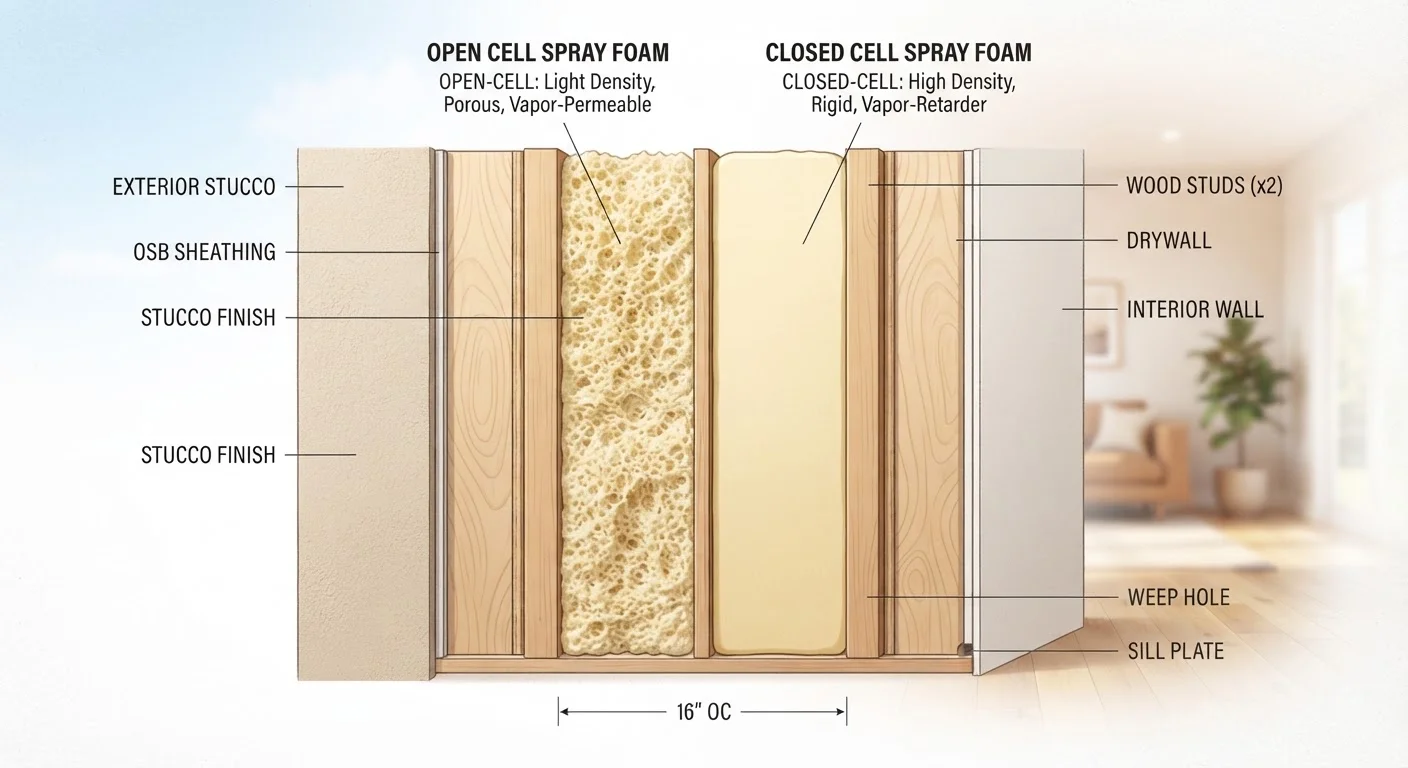
Photo credit: FaqInsider.com
In this article
Spray foam comes in two very different forms. Here's how open-cell and closed-cell insulation compare on R-value, moisture control, and cost.
Key Takeaways
- Closed-cell foam delivers roughly twice the R-value per inch compared to open-cell foam.
- Open-cell foam is softer, more affordable, and better suited for interior soundproofing applications.
- Closed-cell foam acts as a vapor retarder; open-cell foam does not and can absorb moisture.
- Both types provide excellent air sealing, which is their primary advantage over batt insulation.
- Professional installation is required for both types due to chemical handling and application safety.
- Choosing the wrong type for a specific location can lead to moisture problems or under-insulation.
What Makes These Two Foams Different
Spray polyurethane foam (SPF) is created when two liquid chemicals - an isocyanate and a polyol resin - are mixed at the nozzle and expand rapidly on contact with a surface. What determines whether that foam becomes open-cell or closed-cell is how its cellular structure forms as it cures.
Open-cell foam has a soft, spongy texture because the tiny gas bubbles (cells) that form during expansion rupture and remain open. This gives the material a low density and allows air - and eventually moisture vapor - to pass through it.
Closed-cell foam cures with intact, sealed cells packed tightly together. This rigid structure traps an insulating gas inside each cell, which is what drives its dramatically higher R-value. It also means water vapor cannot easily penetrate the material.
Understanding this structural difference is the key to every practical decision that follows - R-value, moisture behavior, and appropriate applications all trace back to whether those cells are open or closed. If you're uncertain how R-value fits into your broader insulation plan, common insulation misconceptions are worth reviewing before you decide.
R-Value and Thermal Performance
R-value measures a material's resistance to heat flow - the higher the number, the better the insulating performance. This is where the two foams diverge most sharply.
| Criterion | Open-Cell Foam | Closed-Cell Foam |
|---|---|---|
| R-value per inch | ~R-3.5 to R-4 | ~R-6 to R-7 |
| Vapor permeability | High (permeable) | Low (vapor retarder) |
| Density | Low (~0.5 lb/ft³) | High (~2 lb/ft³) |
| Relative cost | Lower per board foot | Higher per board foot |
| Best location | Interior walls, attic floors | Crawl spaces, basements, exteriors |
| Soundproofing | Excellent | Moderate |
| Structural contribution | Minimal | Adds wall rigidity |
Open-cell foam typically achieves around R-3.5 to R-4 per inch. Closed-cell foam reaches R-6 to R-7 per inch, roughly double. In a standard 2×4 wall cavity (about 3.5 inches deep), open-cell foam yields approximately R-13, while closed-cell foam can deliver R-21 to R-24 in the same space.
This difference matters most when cavity depth is limited or when local building codes demand a minimum R-value that open-cell foam cannot reach without exceeding available depth. Signs your insulation is underperforming can help you gauge whether your current setup is falling short of what your climate demands.
~2x
R-value advantage of closed-cell per inch
Closed-cell foam's intact cellular structure traps insulating gas, roughly doubling thermal resistance compared to open-cell at the same thickness.
R-21+
Closed-cell performance in a 2×4 wall cavity
A standard 3.5-inch wall cavity filled with closed-cell foam can exceed R-21, surpassing what open-cell foam can achieve in the same space.
<1.0 perm
Vapor permeability of closed-cell foam
At typical application thicknesses, closed-cell foam generally meets the definition of a Class II vapor retarder per building science standards.
Moisture Control: A Critical Difference
Moisture management is where choosing the wrong foam type causes real, lasting damage. Open-cell foam has a high vapor permeability - it allows moisture vapor to move through it. In dry interior applications, this isn't a problem. But in crawl spaces, basement walls, or any area exposed to groundwater or exterior humidity, open-cell foam can absorb and hold moisture, creating conditions favorable for mold growth and wood rot.
Closed-cell foam, by contrast, functions as a Class II vapor retarder (typically 0.1 to 1.0 perms at typical thicknesses). This means it significantly slows vapor movement, making it the appropriate choice wherever moisture is a routine concern.
Vapor Retarders and Local Code Requirements
Whether a vapor retarder is required - and on which side of the wall assembly - depends on your climate zone. In cold climates, vapor control is typically placed on the warm-in-winter (interior) side; in hot-humid climates, requirements differ. Because closed-cell foam acts as a vapor retarder itself, adding a separate poly vapor barrier in the same assembly can trap moisture between layers. Always verify the appropriate wall assembly design with a qualified building professional and check your local code before specifying materials.
For attics, the right choice depends on how the space is configured. A vented attic typically uses insulation at the floor level, where either foam type might be appropriate depending on the design. An unvented (conditioned) attic - where insulation is applied to the roof deck - may specifically require closed-cell foam or a combination approach to manage condensation risk. How insulation and ventilation interact in the attic explains these dynamics in detail.
Cost, Installation, and Practical Considerations
Open-cell spray foam generally costs less per board foot than closed-cell foam, sometimes significantly so. However, because closed-cell foam achieves higher R-values in less thickness, the total installed cost per R-value unit can be more competitive than the raw material price suggests. Get quotes that compare cost per R-value achieved, not just cost per square foot.
Both types require professional installation. The chemicals involved are hazardous before curing, require precise mixing ratios, and demand proper personal protective equipment and ventilation. This is not a DIY project, and most local building codes require permits for significant insulation work - check your municipality's requirements before any project begins.
Open-cell foam also expands dramatically (up to 100 times its liquid volume), which means installers must carefully control application thickness. Closed-cell foam expands less aggressively, making it easier to apply in precise, thin lifts. Very thick applications of closed-cell foam must be done in multiple passes to prevent overheating during the exothermic curing reaction.
Finally, consider that closed-cell foam adds measurable structural rigidity to wall assemblies - a secondary benefit in some framing applications - while open-cell foam remains flexible and can accommodate minor structural movement without cracking.

Author
Home & Garden Editorial Team
Home & Garden Editorial Team is the collective byline for our editorial team and contributor network. Articles published under this byline or an editorial pen name are researched, written, and reviewed according to our editorial standards for clarity, consistency, and independence before publication.
View all articles →