
Pet Nutrition Labels Decoded
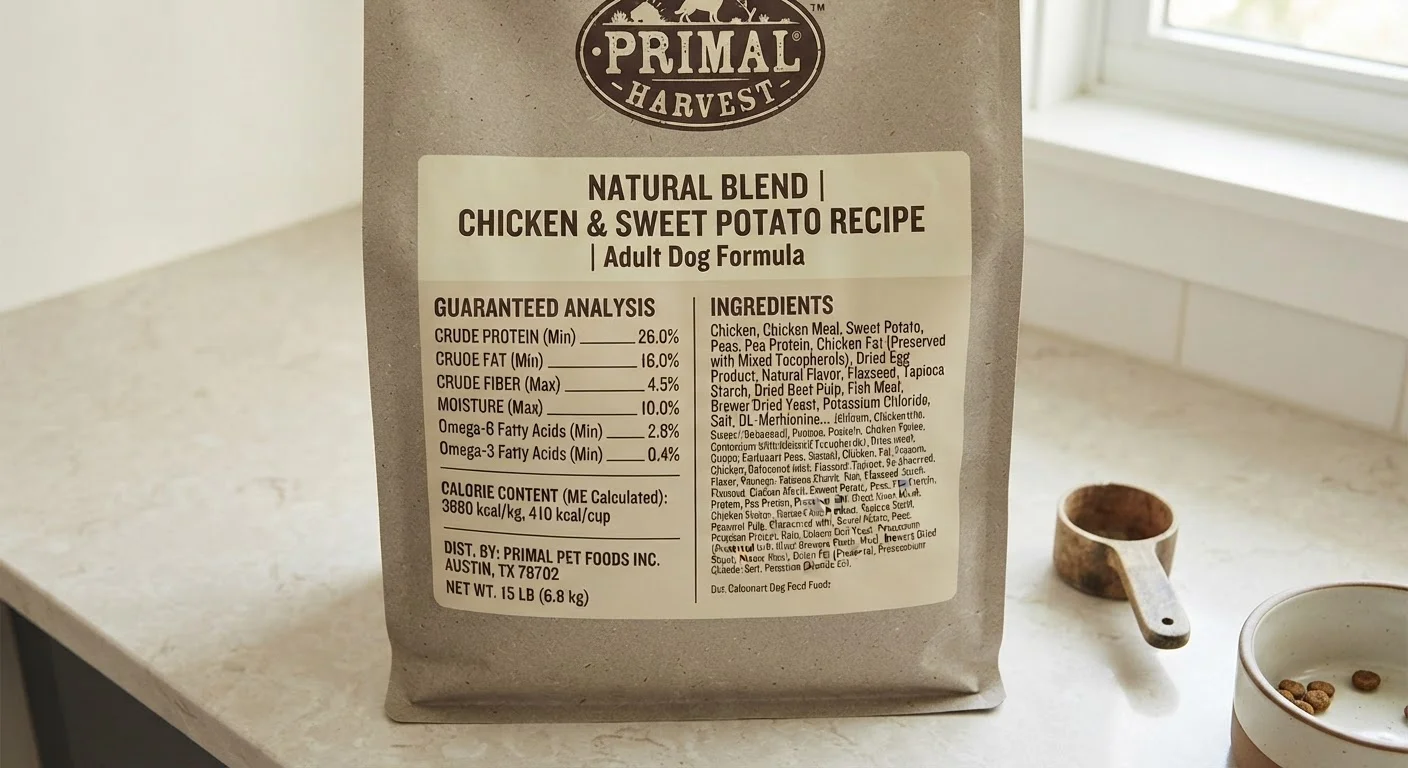
Photo credit: FaqInsider.com
In this article
Ingredient lists, guaranteed analysis, AAFCO statements — a quick reference guide to understanding exactly what pet food packaging is telling you.
The Five Sections Every Pet Food Label Must Have
Federal and state regulations - largely shaped by the AAFCO model - require pet food manufacturers to include specific information on every package. Knowing where to look makes the rest much easier.
| Ingredient list order | By pre-cooking weight, heaviest first (AAFCO Model Bill and Regulations) |
| Required guaranteed analysis nutrients | Crude protein, crude fat, crude fiber, moisture (AAFCO Pet Food Labeling Guidelines) |
| AAFCO adequacy statement options | Formulation method or feeding trial (AAFCO Model Bill and Regulations) |
| Life stage designations | Growth, Adult Maintenance, All Life Stages, Gestation/Lactation (AAFCO Pet Food Labeling Guidelines) |
| Typical moisture in dry kibble | ~10% (General industry range) |
| Typical moisture in canned/wet food | ~75-82% (General industry range) |
These five required elements appear on nearly every bag or can sold in the U.S.: the product name, the net quantity statement, the manufacturer's name and address, the ingredient list, and the guaranteed analysis. A complete AAFCO nutritional adequacy statement is also required for foods marketed as complete and balanced. Each section answers a different question - and together they give you a reasonably full picture of what's inside.
For a deeper look at how this compares to reading a human food label, see how human nutrition labels work.
Ingredient List: What the Order Actually Means
Ingredients are listed in descending order by pre-cooking weight. A named meat like "chicken" appearing first simply means it was the heaviest single ingredient before processing - not necessarily that it dominates the finished product by dry weight.
This is where ingredient splitting can mislead. A manufacturer might list "ground corn," "corn gluten meal," and "corn flour" separately so that each appears lower on the list than a single combined corn entry would. If you add those fractions together, corn could outweigh the first-listed protein.
Ingredient names matter too. "Chicken" refers to clean flesh; "chicken by-product meal" includes organ meats and is not inherently inferior - organs are nutrient-dense - but it is a different ingredient. "Meat and bone meal" is less specific and considered lower quality than a named species meal.
AAFCO
The Association of American Feed Control Officials - a nonprofit organization that establishes model regulations and nutrient profiles used by U.S. states to govern pet food labeling and safety. AAFCO does not directly regulate or test products but sets the standards manufacturers must follow.
Guaranteed Analysis
A required label panel listing minimum or maximum percentages of key nutrients - crude protein, crude fat, crude fiber, and moisture. These are legal guarantees, not precise nutritional targets.
Crude Protein / Crude Fat
Laboratory measurements of total protein and fat content using chemical extraction methods. "Crude" indicates the measurement technique, not the quality or digestibility of those nutrients.
Dry-Matter Basis
A calculation method that removes moisture from the equation so you can compare nutrient levels across foods with very different water content, such as kibble and canned food.
Ingredient Splitting
A labeling practice where a single ingredient source (such as corn) is divided into multiple sub-forms so each appears lower on the ingredient list, making a less prominent protein appear higher.
Life Stage
A designation on the AAFCO adequacy statement indicating which pet life phases a food is formulated to support - such as growth, adult maintenance, or all life stages.
By-Product Meal
Rendered, dried ingredients from an animal source that may include organs, blood, and other parts beyond skeletal muscle. By-products can be nutritionally valuable but are less precisely defined than named muscle meats.
Nutritional Adequacy Statement
A required label statement confirming whether a food is complete and balanced for a given life stage, and whether that claim is backed by nutrient-profile formulation or an actual animal feeding trial.
Guaranteed Analysis: The Four Numbers and What They Don't Tell You
The guaranteed analysis panel lists minimums and maximums for four nutrients: crude protein (minimum), crude fat (minimum), crude fiber (maximum), and moisture (maximum). Manufacturers may add others voluntarily.
Two important caveats: First, "crude" refers to a laboratory measurement method, not quality or digestibility. A food could meet the crude protein minimum using sources your pet absorbs poorly. Second, comparing wet and dry foods directly by these numbers is misleading because moisture content differs dramatically - sometimes 10% vs. 78%. To compare apples to apples, you need to convert both to a dry-matter basis by dividing the nutrient percentage by (100 minus the moisture percentage).
Curious how your pet's coat and energy reflect what they're actually absorbing? your pet's physical appearance can be a useful window into diet quality over time.
AAFCO Statements and Life-Stage Claims
The AAFCO nutritional adequacy statement is arguably the most important line on the label. It tells you whether the food is complete and balanced or intended only as a supplement or treat.
There are two ways a manufacturer can earn this statement: by meeting AAFCO's published nutrient profiles through formulation, or by passing an actual feeding trial with live animals. Feeding-trial foods are generally considered a stronger validation, though both pathways are legitimate.
The statement also specifies a life stage: "All life stages," "Adult maintenance," "Growth" (puppies or kittens), or "Gestation/Lactation." A food labeled for adult maintenance has not been formulated to meet the higher demands of a growing kitten or pregnant dog. Feeding the wrong life-stage food long-term can matter - always check this line first if you have a young or reproducing pet.
For guidance on the wet-versus-dry decision and how label information fits into that choice, see our article on comparing wet and dry pet food formats.
This article is for general informational purposes only and is not a substitute for veterinary nutritional advice. Consult your veterinarian for guidance specific to your pet's health needs.

Author
Pets & Animals Editorial Team
Pets & Animals Editorial Team is the collective byline for our editorial team and contributor network. Articles published under this byline or an editorial pen name are researched, written, and reviewed according to our editorial standards for clarity, consistency, and independence before publication.
View all articles →