
Leash Reactivity in Dogs: What's Actually Happening and How to Address It
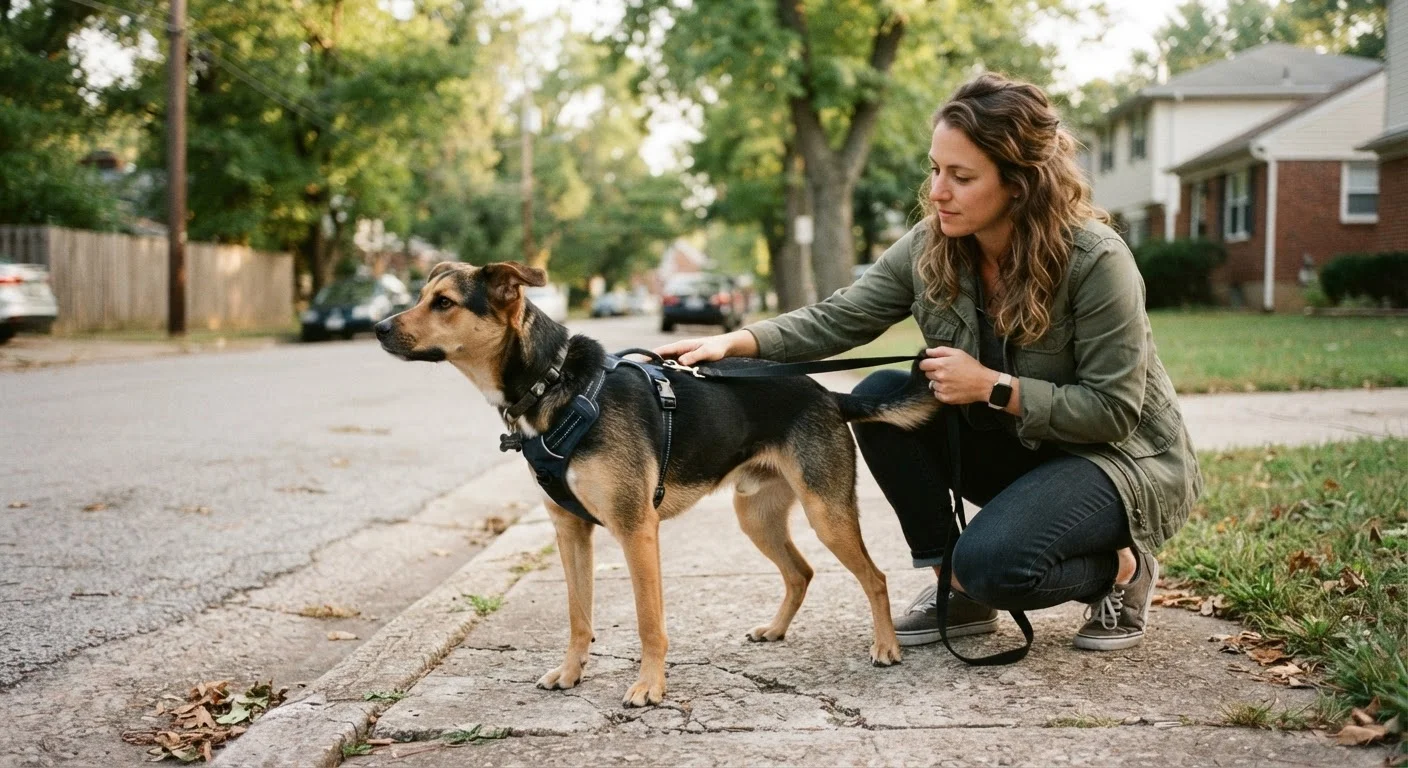
Photo credit: FaqInsider.com
In this article
Lunging, barking, or freezing on leash isn't aggression—it's often fear or frustration. Understand the triggers and proven techniques to help your dog.
Key Takeaways
- Leash reactivity is usually driven by fear or frustration, not aggression.
- The leash itself restricts a dog's ability to flee or investigate, intensifying emotional responses.
- Recognizing early warning signs lets you intervene before a dog reaches full reaction.
- Desensitization and counter-conditioning are the most evidence-supported approaches.
- Consistent management during training prevents the behavior from being rehearsed and reinforced.
- Severe or sudden reactivity may have an underlying medical cause worth ruling out with a vet.
What Leash Reactivity Actually Is
If your dog lunges, barks, or goes rigid the moment it spots another dog, a cyclist, or a stranger on a walk, you're dealing with leash reactivity. It's one of the most common behavioral complaints from dog owners - and one of the most misread.
Leash reactivity is not the same as aggression, though it can look alarming. It refers to an exaggerated emotional response - usually fear, frustration, or over-arousal - that a dog displays specifically when restrained by a leash. Off leash, many reactive dogs are perfectly social. The constraint is what changes the equation.
Understanding the emotional state driving the behavior is essential. To learn more about the mechanisms behind canine reactions, see the science behind canine behavior, which explains how biology and learning history shape everyday actions.
Common Triggers and Why the Leash Makes It Worse
Leash-reactive dogs typically respond to a predictable set of triggers: other dogs, unfamiliar people, fast-moving objects like bikes or skateboards, and sometimes specific sounds. The reaction isn't random - it's tied to whatever that particular dog finds threatening or over-exciting.
The leash compounds the problem in two key ways. First, it removes the option to retreat. Dogs naturally use distance to manage discomfort; when they can't move away, the nervous system escalates. Second, handler tension travels down the leash. An anxious owner gripping tight inadvertently signals danger, amplifying the dog's arousal.
~15-30%
Estimated dogs showing leash reactivity
Behavioral specialists commonly cite this range in clinical practice, though population-wide prevalence studies are limited.
3-8 weeks
Socialization window that shapes reactivity risk
Research on canine development identifies the socialization period as roughly 3 to 8 weeks of age, with effects extending to 12-16 weeks.
70%+
Reactive dogs improve with consistent desensitization
Applied animal behavior literature generally supports desensitization and counter-conditioning as effective for the majority of leash-reactive dogs.
Genetics, early socialization gaps, and past negative experiences all contribute. Dogs that missed key socialization windows as puppies - see how fear periods shape development - are statistically more likely to develop reactive tendencies. Prior traumatic encounters on leash can also create strong associative memories that are triggered quickly and intensely.
Reading Your Dog's Warning Signs
Reactivity has a build-up phase that most owners miss because it happens fast. Learning to spot it early gives you the chance to redirect before your dog crosses their threshold - the point where rational thinking shuts down and pure emotion takes over.
Watch for these escalating signals:
- Orientation: Dog freezes and locks eyes on a trigger.
- Body stiffening: Muscles tighten, tail goes rigid, hackles may rise.
- Piloerection: The hair along the spine stands up.
- Whale eye: Whites of the eyes become visible, often alongside a tucked or averted chin.
- Low growl or whine: Vocalization before full barking begins.
- Forward weight shift or lunging posture: Dog begins leaning toward the trigger.
Intervening at the orientation or stiffening stage is dramatically more effective than waiting until the dog is barking and lunging. That window is your training opportunity.
Treat your dog the moment the trigger appears - not after the barking starts. The timing of the reward is what teaches the emotional association, not the praise you give.
Counter-conditioning works through classical conditioning: the trigger must reliably predict the reward for the association to shift. Even a half-second delay changes what your dog is actually learning.
Keep a 'threshold journal' for two weeks before you start formal training - note exactly how far away a trigger was when your dog first reacted. That distance is your starting point, not your goal.
Reactivity thresholds vary widely between individual dogs and are affected by context, time of day, and stress accumulation. Knowing your specific dog's real baseline prevents setting up failed reps early in training.
Core Training Techniques That Work
Two approaches have the strongest evidence base for leash reactivity: desensitization and counter-conditioning, often used together.
Desensitization means gradually exposing your dog to a trigger at a level that doesn't provoke a reaction - called being sub-threshold - and very slowly closing the gap over many sessions. The goal is for the trigger to become unremarkable through repeated, neutral exposure.
Counter-conditioning pairs the trigger with something the dog genuinely loves - usually high-value food - so the emotional association shifts from negative to positive. The sequence matters: trigger appears, then treat follows. Not the other way around. Over time, the dog begins to anticipate good things when it sees the trigger.
A widely used protocol called the "Look at That" game, developed by trainer Leslie McDevitt, teaches dogs to notice a trigger, glance back at their owner, and receive a reward - building a calm check-in habit rather than an explosive reaction.
Pair these techniques with solid loose-leash walking mechanics. Our guide on teaching a dog to walk politely on a leash covers the foundational skills that make reactive dog training far easier.
Avoid Punishment-Based Methods for Reactivity
Using leash corrections, shock collars, or loud sounds to suppress reactive barking does not address the emotional state driving the behavior. These approaches often suppress warning signals without reducing fear - and can escalate reactivity or damage your dog's trust in you. Evidence-based behavioral guidance consistently recommends positive reinforcement and desensitization as the foundational approach.
Managing Day-to-Day Walks While You Train
Training sessions and daily walks are separate things - and confusing the two is one of the most common setbacks owners experience. If your dog is rehearsing full-blown reactive episodes every evening, those reactions are being practiced and reinforced, even as you work on improvement.
Practical management strategies include:
- Change your route: Avoid known high-trigger areas during the early stages of training.
- Walk at off-peak times: Early mornings and late evenings reduce the chance of encounters.
- Use distance deliberately: Cross the street or turn around before your dog notices a trigger. Distance is your friend.
- Use equipment that gives you control: A well-fitted front-clip harness reduces pulling without causing pain or fear. Avoid tools that use pain or startling - these can worsen reactivity by adding more negative associations.
- Practice a U-turn: Teach your dog to cheerfully spin and walk the other way on cue. This gives you an emergency exit from unexpected triggers.
Think of management as protecting your training investment - not admitting defeat.
When to Bring in Professional Help
Many reactive dogs improve significantly with consistent owner-led training. But some situations benefit from professional support, and recognizing them early saves time and stress.
Consider consulting a certified professional (look for credentials such as CPDT-KA or IAABC membership) if your dog has shown any of the following:
- Reactivity that has intensified quickly over a short period
- A bite history, even if minor
- Reactivity that doesn't improve after several weeks of consistent work
- Reactions that occur inside the home, not just on walks
Sudden changes in behavior - particularly in adult or senior dogs with no prior history - can sometimes point to pain or a medical condition rather than a behavioral issue. This is worth ruling out first. Our guide on when behavior problems need a vet, not a trainer can help you determine whether a veterinary visit should come before a training plan.
It's also worth knowing what reactivity is not. While it shares some surface similarities, it's a different problem from separation-related behavior - for a comparison, see our article on separation anxiety in dogs.
With patience, consistency, and the right approach, leash reactivity is genuinely manageable for the vast majority of dogs. Progress is rarely linear - expect good days and setbacks - but steady improvement is realistic for most owners willing to put in the work.
This article is for general informational purposes and does not constitute veterinary or professional behavioral advice. If your dog's reactivity involves biting or has changed suddenly, consult a licensed veterinarian or certified animal behavior professional.

Author
Pets & Animals Editorial Team
Pets & Animals Editorial Team is the collective byline for our editorial team and contributor network. Articles published under this byline or an editorial pen name are researched, written, and reviewed according to our editorial standards for clarity, consistency, and independence before publication.
View all articles →