Road Signs and Markings Every Driver Should Know Cold
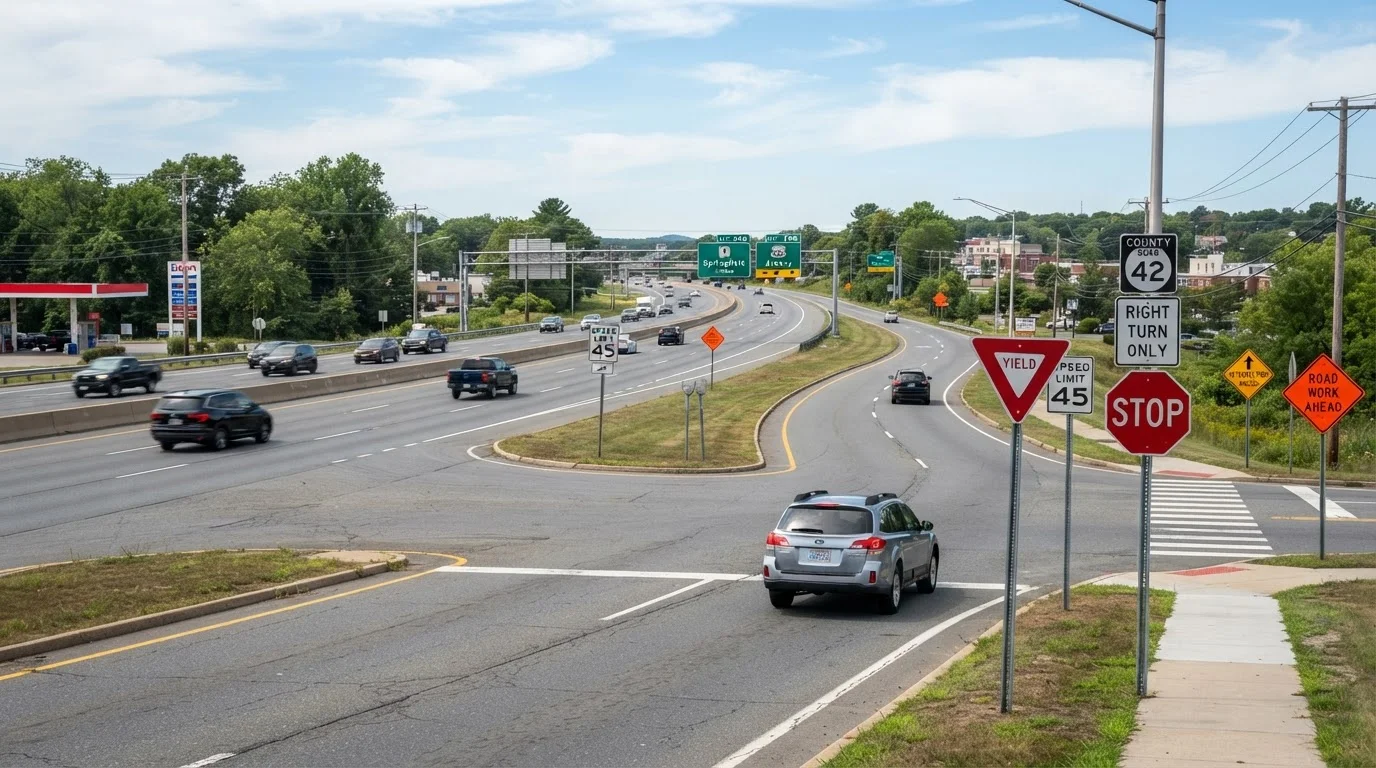
Photo credit: FaqInsider.com
In this article
A practical reference to U.S. road signs, pavement markings, and signal meanings—from standard warnings to lesser-known regulatory signs.
Why Sign Recognition Still Matters for Experienced Drivers
Most drivers pass their road sign test once and never revisit it. Yet traffic engineers continually add and revise signs, pavement markings evolve, and research consistently shows that even licensed adults misread or overlook signs-especially under low-light or high-stress conditions. Sharpening your sign vocabulary is one of the lowest-effort, highest-impact habits you can build. It's also a core part of the safe driving habits that protect you over a lifetime.
The Federal Highway Administration's Manual on Uniform Traffic Control Devices (MUTCD) governs all roadway signs and markings in the United States. Every state adopts it, so the system is nationally consistent-a signal you understand in Texas will mean the same thing in Maine.
Regulatory Signs: Commands You Must Follow
Regulatory signs carry the force of law. Ignoring them can mean a citation, a collision, or both.
- Stop (red octagon): Come to a complete stop behind the stop line. Proceed only when clear.
- Yield (red downward triangle): Slow down and give right-of-way; stop only if necessary.
- Speed Limit (white rectangle): The maximum legal speed under ideal conditions-not a target in poor weather. See how road surfaces change what speed is safe.
- Do Not Enter / Wrong Way: Two separate signs that together warn of one-way roads. Both demand an immediate stop and reversal of direction.
- No Turn on Red: Prohibits the otherwise common right-turn-on-red practice. Often posted at complex intersections or near pedestrian corridors.
- HOV Lane signs: Indicate minimum occupancy requirements (e.g., 2+ or 3+ persons) and hours of enforcement. Penalties for violations vary by state.
Regulatory sign
A traffic sign that communicates a legal requirement-such as stopping, yielding, or obeying a speed limit. Violations can result in traffic citations.
Warning sign
A diamond-shaped sign alerting drivers to a hazard or changing condition ahead, such as a sharp curve or school crossing. These are advisory, not legally prohibitive.
Pavement marking
Lines, symbols, or words painted or applied to the road surface to guide, warn, or regulate traffic movement. They supplement but do not replace sign information.
MUTCD
The Manual on Uniform Traffic Control Devices, published by the Federal Highway Administration. It sets the national standards for all road signs, signals, and markings across every U.S. state.
HOV lane
A High-Occupancy Vehicle lane restricted to vehicles carrying a minimum number of passengers (typically 2 or 3). Hours of restriction and penalties for violations vary by jurisdiction.
Retroreflectivity
The property of road signs and pavement markings that reflects light back toward its source-most notably headlights-making them visible at night. Markings degrade over time and require periodic replacement.
Warning Signs, Guide Signs, and Pavement Markings
Warning signs (yellow diamond-shaped) alert you to conditions ahead that require a change in speed or path-curves, merges, pedestrian crossings, animal crossings, and reduced sight-distance areas. They are advisory, not prohibitive, but ignoring them is how single-vehicle crashes happen.
Guide signs (green or blue rectangles) carry destination, distance, and service information. Interstate shields, exit numbers, and mile markers fall here. Blue service signs point to fuel, food, lodging, and hospital access at upcoming exits.
Pavement markings reinforce and sometimes extend what signs communicate:
- Solid white line: Edge of the roadway or a lane boundary you should not cross.
- Broken white line: Lane separation where crossing is permitted.
- Solid yellow line: Center line; no passing on the side with the solid line.
- Double solid yellow: No passing in either direction.
- Broken yellow line: Passing permitted when safe.
- White stop bar and crosswalk lines: Define where to stop and where pedestrians have legal right-of-way.
- Arrows: Indicate required or permitted lane movements at intersections.
At night, markings can be harder to read-especially in rain, when retroreflective paint loses effectiveness. Pair your sign knowledge with the habits covered in managing night driving hazards.
Lesser-Known Signs Worth Memorizing
These signs trip up even veteran drivers because they appear infrequently or look similar to others:
- Pennant-shaped No Passing Zone sign: Yellow, points right; marks the start of a no-passing zone and is placed on the left side of the road.
- Flashing yellow arrow: Increasingly replacing the traditional green ball at intersections. It means left turns are permitted but you must yield to oncoming traffic and pedestrians.
- White diamonds on pavement (or overhead signs): Reserved lanes-commonly for buses, bicycles, or HOV traffic.
- Orange construction signs: Same shapes and meanings as their permanent counterparts, but fines in work zones are often doubled under state law.
- Circular railroad advance warning sign: A black-on-yellow circle with an X and RR. It appears 500-750 feet before tracks and means be prepared to stop.
- Chevron alignment signs: Repeated black-on-yellow chevrons through sharp curves guide you through the turn when lane lines are hard to track.
Before any long trip, a pre-trip safety walkthrough is also a good moment to mentally review the route's sign environment-construction zones, unfamiliar interchanges, or mountain roads with specialized regulatory signs.

Author
Cars Editorial Team
Cars Editorial Team is the collective byline for our editorial team and contributor network. Articles published under this byline or an editorial pen name are researched, written, and reviewed according to our editorial standards for clarity, consistency, and independence before publication.
View all articles →